Sunda Slow Loris Male Skull Replica
$82.00
They have a distinctive toothcomb, consisting of six forward-facing lower teeth used for grooming. They feature a postorbital bar that circles the eye sockets.
- Description
- Additional information
Description
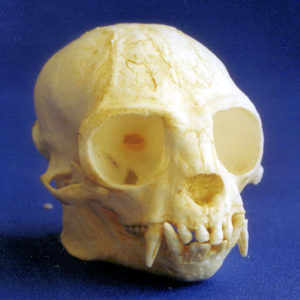
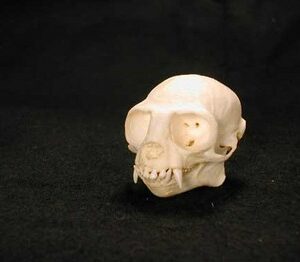
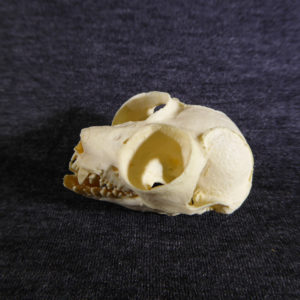
Sunda slow loris male skull replica measures 2.5 x 1.5 x 1.5 inches. The Nycticebus coucang skull is museum-quality polyurethane resin cast from a California Academy of Sciences specimen. 2-part skull (separate cranium and mandible). 1:1 scale. Made in USA.
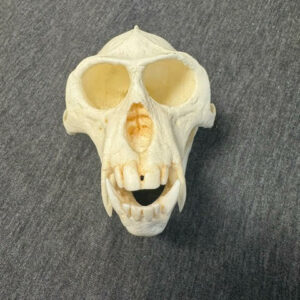
The male cranium features prominent, forward-facing orbits and a shortened facial region. These traits serve as diagnostic markers for the nocturnal strepsirrhine primate. Large orbital cavities allow analysis of the specialized visual adaptations required for low-light navigation.
The zygomatic arches provide secure attachment points for the masticatory muscles. The surface textures and fine suture lines are visible for examination. Such precision provides researchers with a reliable morphological tool for conducting comparative studies.
Scientific Classification
- Kingdom: Animalia
- Phylum: Chordata
- Class: Mammalia
- Order: Primates
- Suborder: Strepsirrhini
- Family: Lorisidae
- Subfamily: Lorinae
- Genus: Nycticebus
- Species: n. coucang
- Type species: Nycticebus coucang (Boddaert, 1785)
- Conservation Status: Endangered (IUCN 3.1)
Researchers can integrate the pygmy slow loris skull replica to analyze subtle variations in cranial size. This comparison highlights the consistency of the lorisidae skull structure. Also, you may use the cotton-top tamarin skull replica to contrast the globular braincase of New World monkeys.
Next, the vervet monkey male skull replica offers a necessary reference. This model shows the transition to the larger, more robust cranial features found in Old World monkeys.
Additional information
| Weight | 2.0 lbs |
|---|---|
| Dimensions | 2.5 × 1.5 × 1.5 in |
| International Monkey Day - December 14th | International Monkey Day has been created to celebrate monkeys on December 14th, as well as “all things simian,” which includes lemurs, tarsiers, apes, and other non-human primates. It is a great day when it comes to raising awareness about different types of monkeys and primates around the world, as well as the issues they face and how we can help them. |