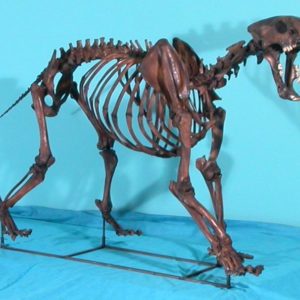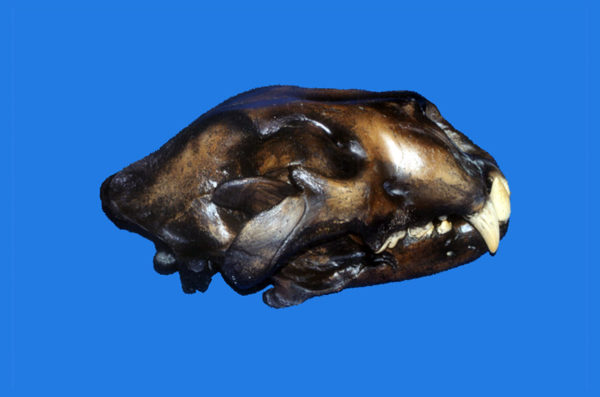


American Lion Skull Replica
$1,200.00
The jaw possesses thick bone deposition at the chin symphysis, showing a specialized ability to shatter the necks of massive ice-age megafauna animal.
- Description
- Additional information
Description
American Lion Skull Replica for Felinology
American lion skull replica measures 18.3 x 11.5 x 12.5 inches. Panthera atrox skull is museum-quality polyurethane resin cast from the Natural History Museum of Los Angeles County Foundation, Page Museum specimen. 1:1 scale. 2-part skull (separate cranium and mandible). Tar Pit Finish. Made in USA.
Phylogenetic analysis reveals American lions may have been diurnal predators unlike modern lions, who are nocturnal predators. The American lion was thought to have been an ambush predator based on the limb proportions.
The mandibular geometry of American lions unambiguously indicates they were specialised to hunt large prey.
American lions likely preyed on mammoths, deers, horses, camels, tapirs, the American bison, and other large ungulates.
Paired nitrogen and carbon isotopic evidence from Natural Trap Cave in Wyoming reveals that the extant pronghorn was an important food source for American lions, which probably hunted them regularly, although probably also could be due to kleptoparasitism from the kills of the American cheetah.
Other than pronghorns, they seem to balance the rest of their diet equally between horses, bisons, and sheeps. In San Luis Potosí, carbon isotopic reveals that American lions hunted in open forests, with its main prey being bisons, pronghorns, horses, and mammoths.
The American lion probably didn’t travel long distances in the search for food and instead stayed close to the springs.
At La Brea tar pits, isotopic analysis of δ15N and δ13C based on bone collagen found that American lion had overlapping values with Smilodon fatalis and dire wolves suggesting high levels of competition between the three large carnivorans.
Scientific Classification
- Kingdom: Animalia
- Phylum: Chordata
- Class: Mammalia
- Order: Carnivora
- Suborder: Feliformia
- Family: Felidae
- Subfamily: Pantherinae
- Genus: Panthera
- Species: †P. atrox
- Binomial name: †Panthera atrox
- Conservation Status: Extinct
While the American lion saber-toothed cat, and the dire wolf, evolved forward-facing orbits for binocular hunting and reinforced mandibular symphyses for subduing prey, the Harlan’s ground sloth possessed deep, robust jaws and lateral orbits to scan for those very predators while grinding abrasive vegetation.
Additional information
| Weight | 9.0 lbs |
|---|---|
| Dimensions | 18.3 × 11.5 × 12.5 in |