


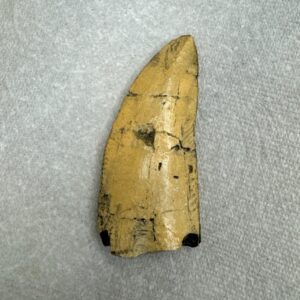
Carcharodontosaur Tooth Replica
$28.00
It had a large, lightly built skull with a triangular rostrum. Its jaws were lined with sharp, recurved, serrated teeth that bear striking resemblances to those of the great white shark, the inspiration for the name.
- Description
- Additional information
Description
Carcharodontosaur tooth replica measures 3.5 inches. Carcharodontosaurus saharicus tooth is museum quality polyurethane resin cast. Made in USA.
Carcharodontosaurus is one of the largest theropod dinosaurs known, with C. saharicus reaching 12–12.5 meters (39–41 ft.) in length and approximately 6–6.2 metric tons (6.6–6.8 short tons) in body mass.
It had a large, lightly built skull with a triangular rostrum. Its jaws were lined with sharp, recurved, serrated teeth that bear striking resemblances to those of the great white shark, the inspiration for the name.
Though giant, its cranium was made lighter by greatly expanded fossae and fenestra, but also making it more fragile than tyrannosaurids’. The forelimbs were tiny whereas the hindlimbs were robust and muscular. Like most other theropods, it had an elongated tail for balance.
Many gigantic theropods are known from North Africa during this period, including both species of Carcharodontosaurus as well as the spinosaurid Spinosaurus, the possible ceratosaur Deltadromeus, the large, dubious theropod Bahariasaurus, and an unnamed large abelisaurid.
Studies of the bite force and tooth anatomy of carcharodontosaurids have found them to possess strong, but relatively weak bites compared to other theropod families. North Africa at the time was blanketed in mangrove forests and wetlands, creating a hotspot of fish, crocodilian, and pterosaur diversity.
Fossils of C. saharicus were first found in marls near Ain Gedid, Egypt in early April 1914 by Austro-Hungarian paleontologist Richard Markgraf. Marls from this region derive from the Cenomanian-aged Bahariya Formation, one of many Cretaceous-aged sites of North Africa.
In Bahariya, Markgraf did extensive collecting of dinosaur skeletons for his employer, German paleontologist Ernst Stromer of the Paläontologisches Museum München (Bavarian State Collection of Paleontology).
The skeleton of Carcharodontosaurus (IPHG 1922 X46) consisted of: a partial skull, including much of the braincase, teeth, three cervical and a caudal vertebra, incomplete pelvis, a manual ungual, femora, and the left fibula.
Carcharodontosaur facts:
Domain: Eukaryota
Kingdom: Animalia
Phylum: Chordata
Clade: Dinosauria
Clade: Saurischia
Clade: Theropoda
Family: Carcharodontosauridae
Subfamily: Carcharodontosaurinae
To visualize the diverse ecological niches of Cretaceous North Africa, researchers can pair this blade-like specimen with a Spinosaurus tooth replica. While the Carcharodontosaurus possessed thin, serrated teeth designed for slicing through the hide of large sauropods, the Spinosaurus featured conical, unserrated teeth optimized for grasping aquatic prey, illustrating a clear anatomical distinction between terrestrial and semi-aquatic apex predators.
Additional information
| Weight | 1.5 lbs |
|---|---|
| Dimensions | 3.5 in |