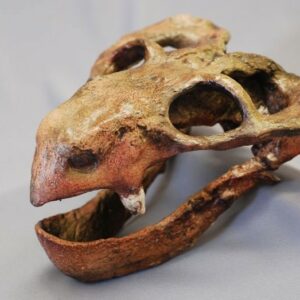


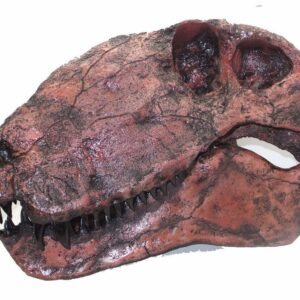
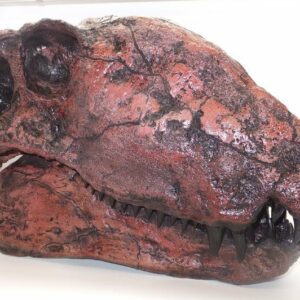
Dimetrodon limbatus Skull Replica
Price range: $1,500.00 through $1,620.00
Their small internal snout ridges plus detached jaw bones reveal how these early land hunters smelled their surroundings to locate their next meal.
- Description
- Additional information
Description
Dimetrodon limbatus skull replica measures 16.9 x 10 x 11 inches. Dimetrodon skull is museum-quality polyurethane resin cast from Brigham Young University specimen. 2-part skull (separate cranium and jaw). 1:1 scale. Made in USA.
In the early 20th century, E.C. case conducted extensive research on Dimetrodon fossils. He received funding from the Carnegie Institution to examine specimens at the American Museum of Natural History. Many of these fossils originated from Cope, who often named species based on minimal bone fragments. Case worked to provide more thorough descriptions of these finds.
Alfred Romer later restudied these specimens during late 1920 Their work reassessed the species names created by Cope and Case. Today, scientists still consider most of the names validated by Romer and Price as legitimate.
Recent discoveries have expanded the known range of this creature beyond Texas and Oklahoma. Paleontologists found fossils in Utah, Arizona, Ohio and New Mexico. Before these finds, researchers believed a midcontinental seaway isolated Dimetrodon. However, these new sites prove the seaway did not block their movement across North America.
The most significant find occurred in 2001 in Germany. Scientists named a new species, D. teutonis, from the Thuringian Forest. This discovery marked the first time anyone identified Dimetrodon fossils outside of North America. These findings continue to reshape our understanding of how these ancient synapsids spread across the globe.
Scientific Classification
- Kingdom: Animalia
- Phylum: Chordata
- Clade: Synapsida
- Family: †Sphenacodontidae
- Subfamily: †Sphenacodontinae
- Genus: †Dimetrodon Cope 1878 (conserved name)
- Type species: †Dimetrodon limbatus Cope 1877
- Conservation Status: Extinct
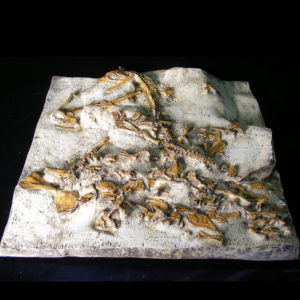
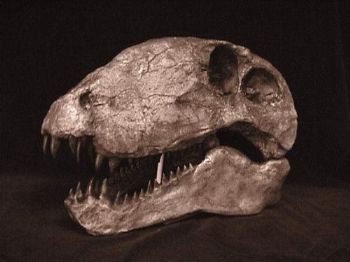
Enhance your Dimetrodon skull with the Gorgonospid skull replica, the Dicynodon skull replica and the Aerosaurus skeleton plaque. While the Dimetrodon represents an early sail-backed form, these other specimens highlight how the lineage split into specialized hunters and herbivores.
The Gorgonospid features massive canine teeth for predation, whereas the Dicynodon displays a beak-like structure for plant eating. Adding the Aerosaurus plaque provides a look at an even earlier branch of the family, allowing visitors to see the deep roots of the lineage that eventually led to mammals.
Additional information
| Weight | 25.0 lbs |
|---|---|
| Dimensions | 16.9 × 10.0 × 11.0 in |
| National Dinosaur Day - June 1st | National Dinosaur Day is celebrated on June 1st every year. It's a day to learn about dinosaurs, including what they looked like, what they ate, and how they became extinct. |
| Mount | No Mount, Yes Add Mount |