



Sigillaria Lycopod Bark Replica
$17.00
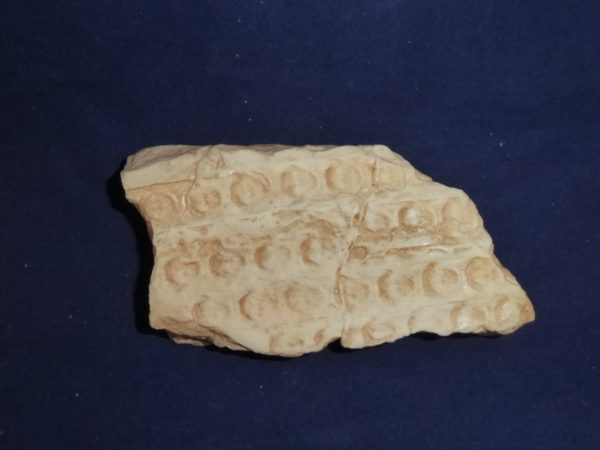
The old leaf bases expanded as the trunk grew in width, and left a diamond-shaped pattern, which is evident in fossils. These leaf scars were arranged in vertical rows.
- Description
- Additional information
Description
Sigillaria Lycopod Bark Replica Slab measures 4.0 x 2.0 inches. The Sigillaria Lycopod Bark Replica is museum-quality polyurethane resin cast. 1:1 scale. Made in USA.
Sigillaria Lycopod Bark from a large tree of the Pennsylvanian carboniferous swamps. Manning Canyon, Utah. Sigillaria Lycopod was a tree-like plant reaching a height up to 30 meters,with a tall, single or occasionally forked trunk that lacked wood.
Support came from a layer of closely packed leaf bases just below the surface of the trunk, while the center was filled with pith. The long, thin grass like leaves were attached directly to the stem and grew in a spiral along the trunk.
The old leaf bases expanded as the trunk grew in width, and left a diamond-shaped pattern, which is evident in fossils. These leaf scars were arranged in vertical rows. The Sigillaria Lycopod trunk had photosynthetic tissue on the surface, meaning that it was probably green.
The Sigillaria Lycopod trunk was topped with a plume of long, grass-like, microphyllous leaves, so that the plant looked somewhat like a tall, forked bottle brush. The plant bore its spores (not seeds) in cone-like structures attached to the stem.
Sigillaria Lycopod, like many ancient lycopods, had a relatively short life cycle – growing rapidly and reaching maturity in a few years. Some researchers have suggested that Sigillaria was monocarpic, meaning that it died after reproduction, though this is not proven. It was associated with Lepidodendron, the scale tree, in the Carboniferous coal swamps.
Additional information
| Weight | 4 lbs |
|---|---|
| Dimensions | 3.9 × 2.36 in |
| Sigillaria Lycopod Facts: | Kingdom: Plantae |