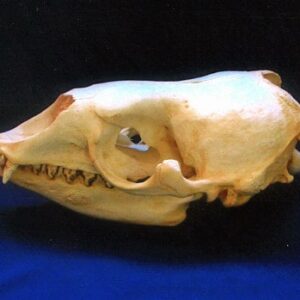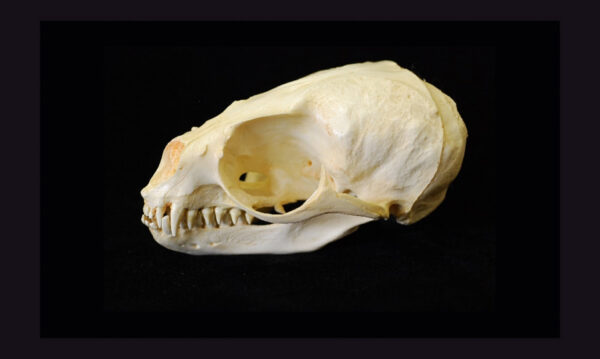
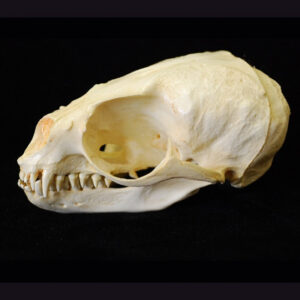
Subantarctic Fur Seal Female Skull Replica
$242.00
The Subantarctic fur seal has a short snout and orange chest. This replica shows the unique skull of the southern hunter that east fish and squid.
- Description
- Additional information
Description
Subantarctic fur seal female skull replica measures 6.9 x 4.2 x 3.1 inches. Arctocephalus tropicalis skull is museum-quality polyurethane resin cast from a California Academy of Sciences specimen. 2-part skull (separate cranium and mandible). 1:1 scale. Made in USA.
The Subantarctic fur seal lives across the Southern Ocean, with large colonies on islands like Gough and Amsterdam. This carnivore hunts for fish and squid in deep waters at night.
Although they were nearly extinct by the 1800’s due to the fur trade, their numbers have soared to roughly 300,000 today. This 1:1 scale replica captures the refined skull of a female, showing the distinct anatomy of a species that successfully rebounded from extreme overhunting.
Scientific Classification
- Kingdom: Animalia
- Phylum: Chordata
- Class: Mammalia
- Order: Carnivora
- Clade: Pinnipedia
- Family: Otariidae
- Genus: Arctocephalus
- Species: A. tropicalis
- Binomial name: Arctocephalus tropicalis
- Conservation status: Least Concern
Placing this piece next to a crabeater skull replica shows the huge size gap between different southern seals. You can add the Weddell seal skull replica to see the bone features used by deep divers in the Antarctic waters. By adding the leopard seal skull replica, it shows the big jaws of the top hunter in these waters.
Additional information
| Weight | 6.0 lbs |
|---|---|
| Dimensions | 6.9 × 4.2 × 3.1 in |
| International Seal Day - March 22nd | Every year on March 22nd, the International Day of the Seal promotes the conservation of seals worldwide. It’s also a day to celebrate this amazing marine mammal. A seal is a type of animal called a pinniped, which is Latin for “fin-footed.” Other pinnipeds include the walrus and sea lion. What makes seals different than other pinnipeds is that they don’t really use their flippers to walk. When on land, they usually slide around on their bellies. In the water, their flippers help them swim really fast. Seals are also much quieter and smaller than their sea lion and walrus cousins. |