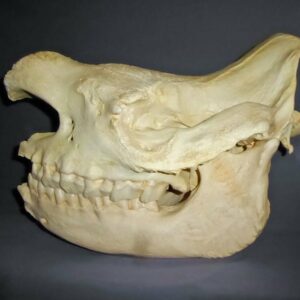
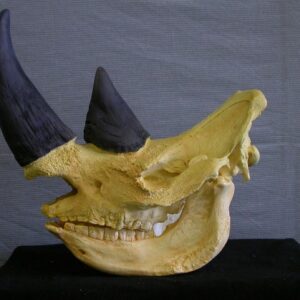
Black Rhinoceros Male Horn Replicas
$334.00
Black rhinoceros male horn replicas are 34.6 x 5.7 x 26.0 in., and 13.3 x 4.8 x 9.5 in. The Diceros bicornis horns are museum-quality polyurethan resin casts of CAS specimens.
- Description
- Additional information
Description
Black rhinoceros male horn replicas measure 34.6 x 5.7 x 26.0 inches, and 13.3 x 4.8 x 9.5 inches. The Diceros bicornis horns are museum-quality polyurethan resin casts of California Academy of Sciences specimen.
The black rhinoceros, also called the hook-lipped rhinoceros, inhabits eastern and southern Africa including Botswana, Kenya, Malawi, Mozambique, Namibia, South Africa, Eswatini, Tanzania, Zambia, and Zimbabwe. Although people call the rhinoceros black, its colors vary from brown to grey.
Several distinct traits seperate the black rhinoceros from the white rhinoceros has a smaller body, skull and ears. It also holds its head higher than the white rhinoceros.
Scientific Classification
- Kingdom: Animalia
- Phylum: Chordata
- Class: Mammalia
- Order: Perissodactyla
- Family: Rhinocerotidae
- Genus: Diceros
- Species: D. bicornis
- Binomial name: Diceros bicornis
- Conservation status: Critically Endangered
Best Buds, the black rhinoceros male horn replicas, are going on a hunting trip in Africa. They are hunting poachers and have their high-powered guns and binoculars ready for the kill.
Night, the black rhinoceros male skull replica, is carrying the high-powered rifle on his strong horns.
Blanco, the white rhinoceros skull replica, has the binoculars strapped over her eyes and will never blink. She wants these guys dead.
Fluffy, the woolly rhinoceros skull replica, is setting the baits with barbecue steak, mashed potatoes and white corn fresh off the barbecue.
It was a good night, they got all of them.
Additional information
| Weight | 30.0 lbs |
|---|---|
| Dimensions | 34.6 × 5.7 × 26.0 in |
| World Rhino Day - September 22nd | World Rhino Day is celebrated on September 22nd each year to raise awareness and funds for the five rhino species: black, white, greater one-horned, Sumatran, and Javan. The day brings together zoos, NGOs, rhino sanctuaries, and concerned citizens from around the world to highlight the threats facing rhinos, such as poaching, habitat loss, disease, and natural disasters. |