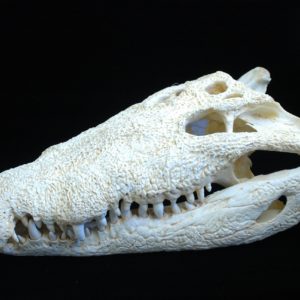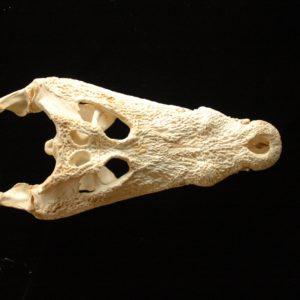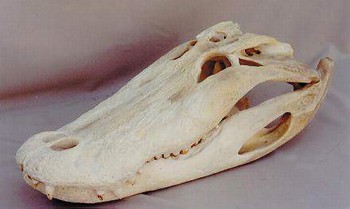
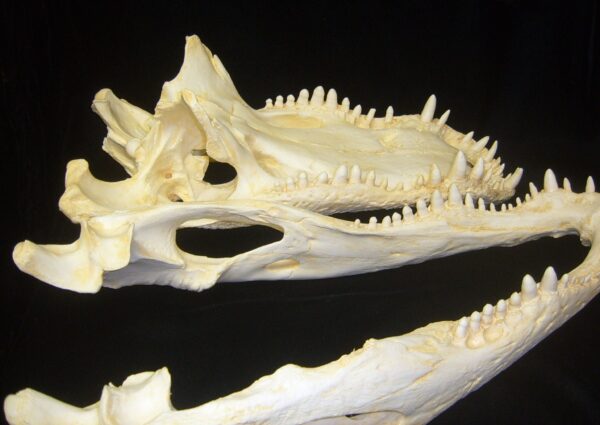


American Alligator Skull Replica
$665.00
The American Alligator (Alligator mississippiensis), sometimes referred to colloquially as a gator or common alligator, is a large crocodilian reptile native to the Southeastern United States and a small section of northeastern Mexico.
- Description
- Additional information
Description
American Alligator Skull Specimen (Replica)
Product Specifications
The American alligator skull is a museum-quality replica. We cast this specimen in durable polyurethane resin. This two-part model features a separate cranium and jaw. Proudly made in the USA, the replica measures 25.0 x 12.0 x 5.0 inches.
Species Overview
The American alligator is often referred to colloquially as a “gator.” It is a large crocodilian reptile native to the Southeastern United States. Additionally, a small population exists in Mexico. Regarding size, adult males measure 11.2 to 15.1 ft. in length and can weigh up to 999 lb. However, females are smaller, measuring 8.5 to 9.8 ft. in length.
Habitat and Identification
The American alligator inhabits freshwater wetlands. These include marshes and cypress swamps from Tamaulipas in Mexico to North Carolina. It is distinguished from the sympatric American crocodile by its broader snout. Furthermore, it has overlapping jaws and darker coloration. While it is less tolerant of saltwater, it is more tolerant of cooler climates.
Diet and Ecosystem Impact
American Alligators are apex predators. Therefore, they consume fish, amphibians, reptiles, birds, and mammals. In contrast, hatchlings feed mostly on invertebrates.
They play an important role as ecosystem engineers in wetland ecosystems. For instance, they create “alligator holes.” These provide both wet and dry habitats for other organisms.
Mating and Development
Throughout the year, American alligators bellow to declare territory and locate suitable mates. Specifically, males use infrasound to attract females. Mothers lay eggs in a nest of vegetation, sticks, leaves, and mud. These nests are usually in a sheltered spot near the water. Young gators are born with yellow bands around their bodies. Consequently, their mother protects them for up to one year.
Conservation History
The conservation status is currently listed as “least concern” by the IUCN. Historically, however, hunting had decimated their population. Because of this, the American alligator was listed as an endangered species in 1973. Subsequent conservation efforts allowed their numbers to increase. As a result, the species was removed from endangered status in 1987.
Scientific classification:
- Kingdom: Animalia
- Phylum: Chordata
- Class: Reptilia
- Order: Crocodilia
- Family: Alligatoridae
- Subfamily: Alligatorinae
- Genus: Alligator Cuvier, 1807
- Type species: Alligator mississippiensis
- Temporal range: Middle Pleistocene–Present
- Conservation status: Least concern (IUCN 3.1)
Related Specimens
If you find this replica interesting, you may also like our American alligator, Nile crocodile, or the broad-snouted caiman. Shop for more museum-quality replicas in our reptile store.
Additional information
| Weight | 30 lbs |
|---|---|
| Dimensions | 25.0 × 12.0 × 8.5 in |
| National Alligator Day - May 29th | National Alligator Day is celebrated annually on May 29 to raise awareness of the importance of alligators and their need for conservation. Alligators are the state reptile of Florida, Louisiana, and Mississippi, and can be found throughout the Southern United States in freshwater lakes, marshes, swamps, rivers, canals, and the Everglades. |