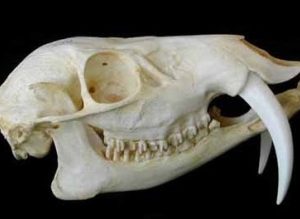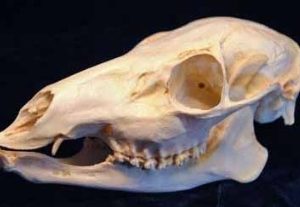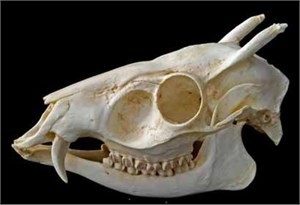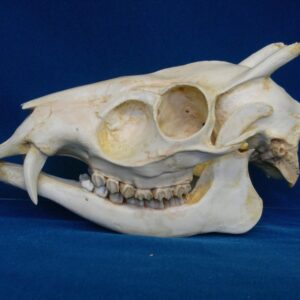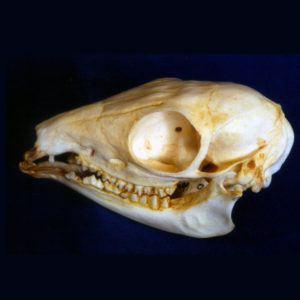
Asiatic Mouse Deer Adult Female Skull Replica

$91.00

The greater mouse-deer is a species of even-toed ungulate found in Sumatra, Borneo, and smaller Malaysian and Indonesian islands, and in southern Myanmar, southern Thailand, and peninsular Malaysia.

SKU: CA02299 Tag:

Description

Asiatic mouse deer adult female skull replica measures 3.3″L. Asiatic mouse deer adult female skull replica is museum-quality polyurethane resin cast from California Academy of Sciences specimen. 2-part skull (separate cranium and mandible). Made in USA.
Asiatic mouse deer or Tragulus napu are small ungulates that make up the family Tragulidae. The Asiatic mouse deer is native to areas of southeast Asia including Thailand, Malaysia, Sumatra and Borneo.
Although these small mammals appear deer-like, they are actually members of the Tragulidae family.
The Asiatic mouse deer is an herbivore, feeding on grasses, leaves, berries and saplings. In place of horns or antlers, the male Asiatic mouse deer possess a large set of impressive canines that it uses in sparing with other males.
The family was widespread and successful from the Oligocene (34 million years ago) through the Miocene (about 5 million years ago), but has remained almost unchanged over that time and remains as an example of early ruminant form.
The Asiatic mouse deer have four-chambered stomachs to ferment tough plant foods, but the third chamber is poorly developed. Though most species exclusively on plant material, the water chevrotain occasionally takes insects and crabs, or scavenges meat and fish.
Like other ruminants, they lack upper incisors. The Asiatic mouse deer or Tragulus napu give birth to only a single young.

Asiatic mouse deer are solitary or live in pairs. The young are weaned at three months of age, and reach sexual maturity between 5 and 10 months, depending on species. Parental care is relatively limited.

Although they lack the types of scent glands found in most other ruminants, they do possess a chin gland for marking each other as mates or antagonists, and, in the case of the water chevrotain, anal and preputial glands for marking territory. Their territories are relatively small, on 32 to 59 acres.

Scientific classification:

  • Kingdom: Animalia
  • Phylum: Chordata
  • Class: Mammalia
  • Order: Artiodactyla
  • Family: Tragulidae
  • Type genus: Tragulus
  • Species: T. napu
  • Conservation status: Least Concern (IUCN 3.1)

Similar to the tusked mouse deer, the male tufted deer possesses visible fangs and a characteristic tuft of hair on its forehead.

Additional information

Weight 2.4 lbs
Dimensions 3.5 in