

Baird’s Beaked Whale Tooth Replica Casts
$52.00
The snout, called a beak, of Braird’s beaked whale is elongated and lacks all teeth except for one or two sets in the lower mandible, which are called “battle teeth” for their use in intra-species conflict.
- Description
- Additional information
Description
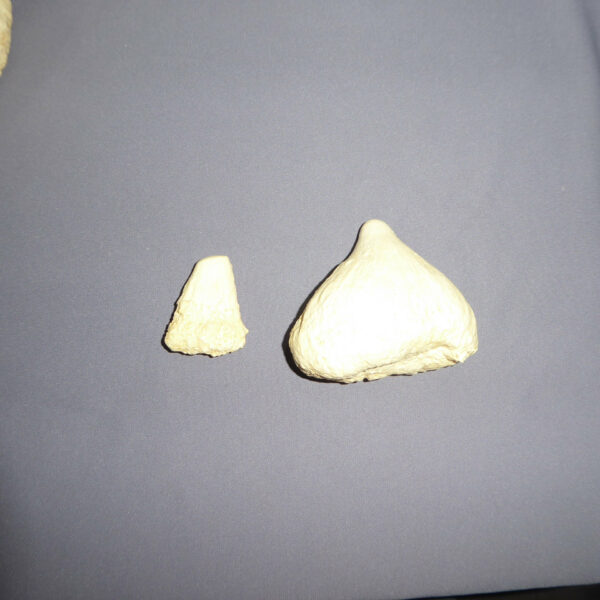
Baird’s Beaked Whale Tooth Replica Casts. Museum-quality polyurethane resin cast from California Academy of Sciences specimen: CAS MAM 23747; Berardius bairdii; Male; Field #RTB 1152; 22 July 1985; 4.5 mi S of Santa Cruz, Santa Cruz County, California. 1:1 scale (Life-size), Made in USA.
Baird’s beaked whale tooth dimensions
Baird’s beaked whales possess two pairs of teeth in the lower mandible. The following measurements refer to the exposed height above the gum line:
Forward Pair (Anterior “Battle Teeth”):
- Height: 3.5 inches (8.9 cm)
- Width: 2.6 inches (6.7 cm)
- Thickness: 1.3 inches (3.2 cm)
Aft Pair (Posterior):
- Height: 2.0 inches (5.1 cm)
- Width: 0.7 inches (1.8 cm)
- Thickness: 0.6 inches (1.6 cm)
Anatomical Context:
The forward pair are large, triangular tusks that erupt at the tip of the lower jaw and are visible outside the mouth even when it is closed. The smaller aft pair is positioned approximately 8.0 inches (20 cm) behind the forward pair in the mandible.
Baird’s beaked whale or Berardius bairdi is found in the northern Pacific Ocean, the Sea of Japan and the southern part of the Sea of Okhotsk.
Specimens have been recorded as far north as the Bering Sea and as far south as the Baja California peninsula. Baird’s beaked whale is the largest of the beaked whales, has an estimated population around 30,000 individuals, sometimes reaching a maximum length of 42 feet. This species may be the only large beaked whale found in the North Pacific.
Baird’s beaked whales are unique among toothed whales in that most species only have one pair of teeth. The teeth are tusk-like, but are only visible in males, which are presumed to use these teeth in combat for females for reproductive rights. In females, the teeth do not develop and remain hidden in the gum tissues.
The throats of all beaked whales have a bilaterally paired set of grooves that are associated with their unique feeding mechanism, suction feeding.
Instead of capturing prey with their teeth, beaked whales suck it into their oral cavity. Suction is aided by the throat grooves, which stretch and expand to accommodate food.
Their tongues can move very freely. By suddenly retracting the tongue and distending the gular (throat) floor, pressure immediately drops within the mouth, sucking the prey in with the water.
Dietary information is available from stomach contents analyses of stranded Bairds beaked whales and from whaling operations.
Their preferred diet is primarily deep water squid, but also benthic and benthopelagic fish and some crustaceans, mostly taken near the sea floor.
Baird’s beaked whale facts:
Conservation status: Least Concern (IUCN 3.1)
CITES Appendix I (CITES)
Scientific classification
Domain: Eukaryota
Kingdom: Animalia
Phylum: Chordata
Class: Mammalia
Order: Artiodactyla
Infraorder: Cetacea
Family: Ziphiidae
Genus: Berardius
Species: B. bairdii
Binomial name: Berardius bairdii
These teeth are essential anatomical companions to our museum-grade Baird’s beaked whale male skull replica cast.
Our Baird’s beaked whale replicas are authentic, 1:1 scale (Life size) reproductions molded from CAS MAM 23747; Berardius bairdii; Male; Field #RTB 1152; 22 July 1985; 4.5 mi S of Santa Cruz, Santa Cruz County, California.
Additional information
| Weight | 5.0 lbs |
|---|---|
| Dimensions | 5.0 × 4.0 × 2.0 in |
You may also like…
-

-


Killer Whale Skull Replica
Price range: $1,300.00 through $1,650.00Select options This product has multiple variants. The options may be chosen on the product pageQuick View -