
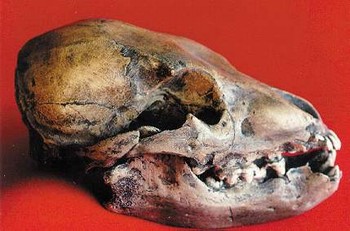

Cave Bear Cub Skull Replica
$171.00
The skull contains a massive, complex nasal cavity, housing turbinates that give them an incredible sense of smell, over 2,000 times better than a human.
- Description
- Additional information
Description
Cave bear cub skull replica measures 8.3″ x 5.5″ x 4.1″. Cave bear cub skull is museum-quality polyurethane resin cast. 2-part skull (separate cranium and jaw). Made in USA.
The cave bear had a very broad, domed skull with a steep forehead. Its stout body had long thighs, massive shins and in-turning feet, making it similar in skeletal structure to the brown bear.
Cave bears were comparable in size to the largest modern-day bears. The average weight for males was 770 to 1,320 lbs. while females weighed 495 to 550 lb. Of cave bear skeletons in museums, 90 percent are male due to a misconception that the female skeletons were merely “dwarfs”.
Cave bears grew larger during glaciations and smaller during interglacials, probably to adjust heat loss rate.
Cave bears of the last Ice Age lacked the usual two or three premolars present in other bears; to compensate, the last molar is very elongated, with supplementary cusps.
The humerus of the cave bear was similar in size to that of the polar bear, as were the femora of females. The femora of male cave bears, however, bore more similarities in size to those of Kodiak bears. Cave bear teeth were very large and show greater wear than most modern bear species.
The morphological features of the Cave bear chewing apparatus, including loss of premolars, have long been suggested to indicate their diets displayed a higher degree of herbivory than the Eurasian brown bear. Indeed, a solely vegetarian diet has been inferred on the basis of tooth morphology.
Some evidence points toward the occasional inclusion of animal protein in cave bear diets. Toothmarks on cave bear remains in areas where cave bears are the only recorded potential carnivores suggests occasional cannibalistic scavenging.
The cave bear was a species of bear that lived in Europe during the Pleistocene and became extinct at the beginning of the Last Glacial Maximum, about 27,500 years ago.
Scientific classification:
- Kingdom: Animalia
- Phylum: Chordata
- Class: Mammalia
- Order: Carnivora
- Family: Ursidae
- Genus: Ursus
- Species: †U. spelaeus
- Binomial name: †Ursus spelaeus
- Temporal range: Middle to Late Pleistocene
- Conservation status: Extinct
Cave bear collection:
Shop more museum-quality bear skulls in our bear skull store
Additional information
| Weight | 4.5 lbs |
|---|---|
| Dimensions | 8.3 × 5.5 × 4.1 in |


