Common Marmoset Skull Replica
$109.00
Their eyes are frontally positioned, which allows for overlapping visual fields and the depth perception necessary for visually guided reaching and grasping.
- Description
- Additional information
Description
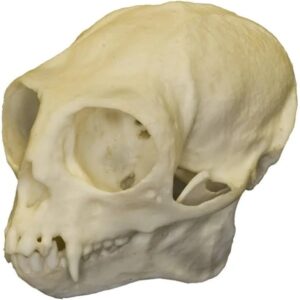
Common marmoset skull replica measures 1.8 x 1.1 x 1.3 inches. Callithrix jacchus skull is a museum-quality polyurethane resin cast from California Academy of Sciences specimen. 2-part skull (separate cranium and mandible). 1:1 scale. Made in USA.
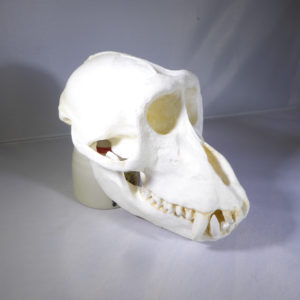
This common marmoset skull reveals the specialized anatomy of one of the world’s smallest New World primates. The bone surfaces show a short facial region and a relatively large braincase for its body size. You will notice that the high-quality resin mimics the porous texture of the real skeletal.
The dental assembly reflects unusually large, chisel-shaped incisors used for gnawing holes in the tree bark to access sap and gum. This cast is a perfect tool for studying the unique dietary adaptations of marmosets.
Scientific Classification
- Kingdom: Animalia
- Phylum: Chordata
- Class: Mammalia
- Order: Primates
- Suborder: Haplorhini
- Infraorder: Simiiformes
- Family: Callitrichidae
- Genus: Callithrix
- Species: C. jacchus
- Binomial name: Callithrix jacchus (Linnaeus, 1758)
- Conservation status: Least Concern (IUCN 3.1)
The miniature proportions of this marmoset specimen offers a unique benchmark for evaluating other primate replicas. This life-size model serves as the definitive model for studying the specialized dental adaptations of tree-gouging gummivores.
To fully appreciate the extreme divergence in New World primate evolution, researchers often sideboard this specimen, specifically the golden-headed lion tamarin skull replica the crab-eating macaque skull replica and the Philippine flying lemur skull replica. To contrast its delicate cranial architecture and chisel-shaped incisors against the more robust facial structures.
Additional information
| Weight | 1.5 lbs |
|---|---|
| Dimensions | 1.8 × 1.1 × 1.3 in |
| International Monkey Day - December 14th | International Monkey Day has been created to celebrate monkeys on December 14th, as well as “all things simian,” which includes lemurs, tarsiers, apes, and other non-human primates. It is a great day when it comes to raising awareness about different types of monkeys and primates around the world, as well as the issues they face and how we can help them. |