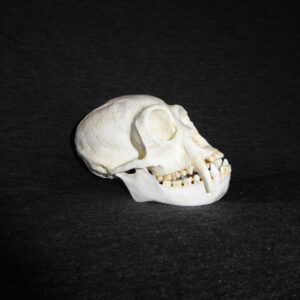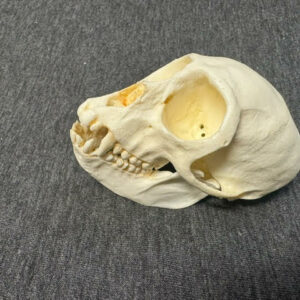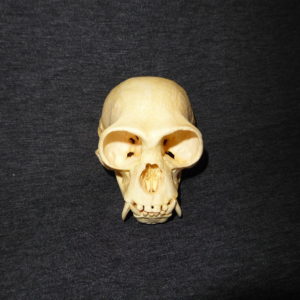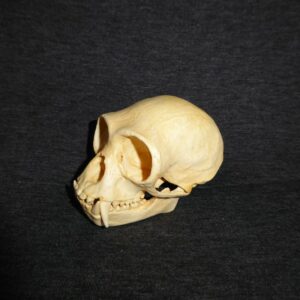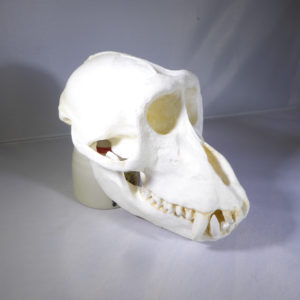


Crab-eating Macaque Monkey Skull Replcia
$182.00
Crab-eating macaque monkey skull replica is 3.9 x 2.4 x 2.5 in. Macaca fascicularis skull is a museum-quality polyurethane resin cast of a CAS specimen.
- Description
- Additional information
Description
Crab-eating macaque monkey skull replica measures 3.9 x 2.4 x 2.5 inches. Macaca fascicularis skull is a museum-quality polyurethane resin cast from California Academy of Sciences specimen. Two-part skull (separate cranium and mandible). 1:1 scale. Made in USA.
The crab-eating macaques are native to Southeast Asia. Their geographical range spreads across this entire tropical region.
They thrive near human settlements and in secondary forests. People have developed a variety of cultural perceptions about them. They view them as smart, adaptive, sacred, or even as pests in some cases. Locals in Indonesia and Malaysia know them and other macaque as kera.
This species has several common names. People often refer to it as the long-tailed macaque due to its tail length. Their tail matches the length of their body and head combined.
The name crab-eating macaque refers to people seeing them foraging beaches for crabs. Laboratories use another common name for them, which is the cynomolgus monkey. This primate is the most traded primate species. It is also the most popular species for scientific research.
They are omnivores and frugivorous. Their diet includes fruits, insects, crabs, and small animals found along the coastlines. These highly intelligent primates use stone tools in daily foraging. They live in matrilineal groups ranging from 10 to 85 individuals. Males always emigrate from their natal group at puberty.
Scientific Classification
- Kingdom: Animalia
- Phylum: Chordata
- Class: Mammalia
- Order: Primates
- Suborder: Haplorhini
- Infraorder: Simiiformes
- Family: Cercopithecidae
- Genus: Macaca
- Species: M. fascicularis
- Binomial name: Macaca fascicularis Raffles, 1821
- Conservation status: Endangered
Gladys, the crab-eating macaque monkey wants to go to the aquarium with her friends. She is excited to hold a sea urchin in the tide pool area.
Wilma, the white-handed gibbon skull replica, is wondering what the weather is going to be like today, and what she should wear.
John Wayne, the western hoolock gibbon skull replica is hoping they have an archery playland there so he can play the duck gallery game.
Veronica, the vervet monkey skull replica, can’t wait to go shopping in the gift shop to buy herself a very expensive souvenir and get her mom one too.
Additional information
| Weight | 4.0 lbs |
|---|---|
| Dimensions | 3.9 × 2.4 × 2.5 in |
| International Monkey Day - December 14th | International Monkey Day has been created to celebrate monkeys on December 14th, as well as “all things simian,” which includes lemurs, tarsiers, apes, and other non-human primates. It is a great day when it comes to raising awareness about different types of monkeys and primates around the world, as well as the issues they face and how we can help them. |