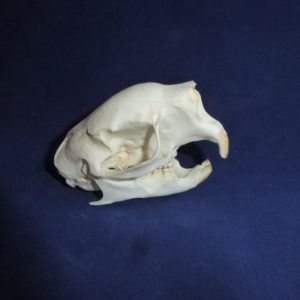
African Crested Porcupine Skull Replica
$91.00
African crested porcupine skull replica is 5.5 x 3.0 x 3.8 in. The Hystrix cristata skull is a museum-quality polyurethane resin cast of a CAS specimen. 1:1 scale. Made in USA.
- Description
- Additional information
Description
African crested porcupine skull replica measures 5.5 x 3.0 x 3.8 inches. The Hystrix cristata skull is a museum-quality polyurethane resin cast of a California Academy of Sciences specimen. 2-part skull (separate cranium and mandible). 1:1 scale. Made in USA.
The African crested porcupine originates across more than 30 nations in North and sub-Saharan Africa. Wild populations also thrive throughout mainland Italy and across the Mediterranean island of Sicily.
The African Crested porcupine stands as the largest porcupine species on earth. These large rodents weigh anywhere from 29 to 60 pounds.
Scientific Classification
- Kingdom: Animalia
- Phylum: Chordata
- Class: Mammalia
- Order: Rodentia
- Family: Hystricidae
- Genus: Hystrix
- Species: H. cristata
- Binomial name: Hystrix cristata
- Conservation status: Least Concern
Corral, the African crested porcupine skull replica, is at the lake with her friends. They are having a rock skipping contest to see who can throw the farthest and skip the rock the most.
Nibbles, the North American porcupine skull replica, went first and her rock just went straight down without even a splash.
Twirl, the prehensile-tailed porcupine skull replica, used her tail to throw her rock and it went around in circles in the water.
Clover, the Asiatic brush-tailed porcupine skull replica, won the competition because it went the farthest and skipped seven times.
Additional information
| Weight | 6.0 lbs |
|---|---|
| Dimensions | 5.5 × 3.0 × 3.8 in |
| World Porcupine Day - July 2nd | July 2nd is World Porcupine Day. These herbivore mammals are highly recognizable by their coat of needle-like quills that remind predators not to mess with them! The sharp quills detach easily when touched but are replaced quickly after losing them. A single animal may have 30,000 or more quills! |