


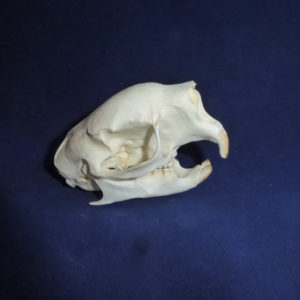


Prehensile-tailed Porcupine Skull Replica
$91.00
Prehensile-tailed porcupine skull replica is 3.3 x 2.3 x 2.0 in. The Coendou prehensilis skull is museum-quality polyurethane resin cast of a CAS specimen.
- Description
- Additional information
Description
Prehensile-tailed porcupine skull replica measures 3.3 x 2.3 x 2.0 inches. The Coendou prehensilis skull is museum-quality polyurethane resin cast of California Academy of Sciences specimen. 2-part skull (separate cranium and mandible). 1:1 scale. Made in USA.
The prehensile-tailed porcupine lives in the South American forests of Venezuela, Guiana, Brazil, Bolivia, Paraguay, Trinidad, and some extreme northern sections of Argentina.
They have short, thick quills and their body color ranges from yellowish to almost black. The front and hind feet are also modified for grasping and their limbs all contribute to making this animal an adept climber. They live most of their lives in trees.
They feed on leaves, shoots, fruits, bark, roots, and buds. They make a distinctive “baby-like” sound to communicate in the wild. They weigh from 4 to 11 pounds.
This species does not hesitate to attack and adversary. It defends itself by biting or sitting on its haunches to shake its quills. They will stamp their hind feet when excited and curl up to protect their soft underbelly.
The female gives birth to just one baby per litter. Twins remain extremely rare for this arboreal species. The mother has a long gestation period lasting about 200 days.
Scientific Classification
- Kingdom: Animalia
- Phylum: Chordata
- Class: Mammalia
- Order: Rodentia
- Family: Erethizontidae
- Subfamily: Erethizontinae
- Genus: Coendou Lacépède, 1799
- Species: C. prehensilis
- Binomial name: Coendou prehensilis
- Conservation status: Least concern (IUCN 3.1)
Twirl, the prehensile-tailed porcupine skull replica, is finally brave enough to jump off the springboard high diving board at Saratoga High School in Saratoga, California. It took a lot of nerve but she did it.
Pokey, the African crested porcupine skull replica, decided it would be a good idea to sneak up behind her and push her when she was standing on the very edge while the lifeguard was not watching.
Spike, the North American porcupine skull replica, the other lifeguard saw what had happened to poor Twirl and immediately called Pokey’s mom to come pick him up.
Brushy, the Asiatic brush-tailed porcupine skull replica, was comforting Twirl and wrapped her towel around her. She sat her down on the plastic lounge chairs. All of a sudden Twirl jumped up and started dancing, grooving to Mick Jagger’s hit song I Can’t Get No Satisfaction.
Additional information
| Weight | 2.3 lbs |
|---|---|
| Dimensions | 3.3 × 2.3 × 2.0 in |
| World Porcupine Day - July 2nd | July 2nd is World Porcupine Day. These herbivore mammals are highly recognizable by their coat of needle-like quills that remind predators not to mess with them! The sharp quills detach easily when touched but are replaced quickly after losing them. A single animal may have 30,000 or more quills! |


