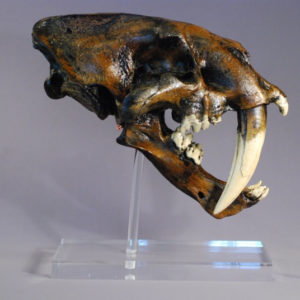
Dimetrodon Skull Replica
Price range: $1,200.00 through $1,340.00
Purchase this life-sized American-crafted reproduction featuring two detached components plus diverse dental anatomy for any prehistoric collection.
- Description
- Additional information
Description
Dimetrodon lived as a quadrupedal, sail-backed synapsid during the Early Permian. Most species reached lengths between 6 and 15 feet and weighed from 60 to 500 lbs. While D. angelenis grew to 15 feet, D. teutonis measured only 24 inches. These larger species ranked amount the top predators of their time, though the related Tappenosaurus possibly grew even larger.
A massive neural spine sail defines the appearance of Dimetrodon. This sail formed from long spines that extended from its vertebrae. The creature walked on four legs and possessed a tall, curved skull with varied tooth sizes. Paleontologists find most fossils in the Red Beds of Texas and Oklahoma, though recent discoveries also come from Germany.
Popular culture often incorrectly labels Dimetrodon as a dinosaur. In reality, it went extinct 40 million years before dinosaurs appeared. Although it looks like a reptile, Dimetrodon shares a closer relationship with mammals.
It belongs to the synapsids, a group characterized by a single skull opening behind each eye. This lineage eventually led to modern mammals, setting them apart from the reptiles and birds of the Sauropsida clade.
Scientific Classification
- Kingdom: Animalia
- Phylum: Chordata
- Clade: Synapsida
- Family: †Sphenacodontidae
- Subfamily: †Sphenacodontinae
- Genus: †Dimetrodon Cope 1878 (conserved name)
- Type species: †Dimetrodon limbatus Cope 1877
- Conservation Status: Extinct
Connect the Dimetrodon skull to the Dimetrodon limbatus articulated skeleton replica to showcase the full profile of this Permian synapsid. While its sail-backed frame appears reptilian, its unique skull architecture links it directly to mammals rather than dinosaurs.
You can further illustrate this evolutionary journey by adding the platypus skeleton replica and the saber-toothed cat skull replica to your collection. These specimens represent transition from early “stem-mammals” to modern egg-laying monotremes and eventually to the specialized predators of the Ice Age.
Additional information
| Weight | 12 lbs |
|---|---|
| Dimensions | 13.0 × 8.0 × 9.0 in |
| Mount | No Mount, Yes Add Mount |