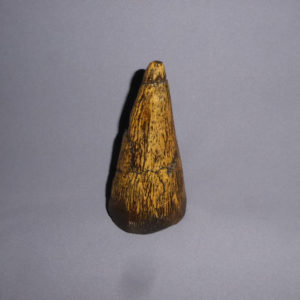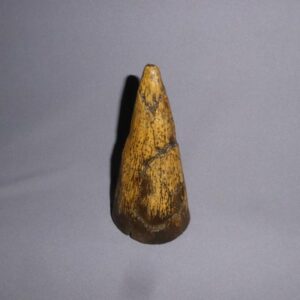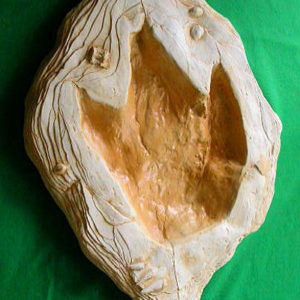

Iguanodon Dinosaur Large Footprint Replica
$138.00
Iguanodon were bulky herbivores that could shift from bipedality to quadrupedality. Iguanodon is estimated to have weighed about 3.4 tons on average. The legs were powerful, but not built for running, and each foot had three toes.
- Description
- Additional information
Description
Iguanodon dinosaur large footprint replica measures 18.0″L x 27.0″W x 3.0″H. Iguanodon dinosaur large footprint replica is museum-quality polyurethane resin cast of original specimen. Made in USA.
The Iguanodon Print imprint size is 13.5″ x 16″. Also contains imprints of: brachiopods, bivalves, & spinosaurus.
Iguanodon meaning “iguana-tooth” or Iguanodon bernissartensis named in 1825, is a genus of ornithopod dinosaur that existed roughly halfway between the first of the swift bipedal hypsilophodontids of the mid-Jurassic and the duck-billed dinosaurs of the late Cretaceous.
Iguanodon were bulky herbivores that could shift from bipedality to quadrupedality. Iguanodon is estimated to have weighed about 3.4 tons on average, and measured about 33 feet long as an adult. These animals had large, tall but narrow skulls, with toothless beaks probably covered with keratin, and teeth like those of iguanas, but much larger and more closely packed.
The arms of iguanodon were long and robust, with rather inflexible hands built so that the three central fingers could bear weight. The thumbs were conical spikes that stuck out away from the three main digits. In early restorations, the spike was placed on the animal’s nose.
Later fossils revealed the true nature of the thumb spikes, although their exact function is still debated. The little finger was elongated and dextrous, and could have been used to manipulate objects. The legs were powerful, but not built for running, and each foot had three toes.
The backbone and tail were supported and stiffened by ossified tendons, which were tendons that turned to bone during life.
The largest find of iguanodon remains to that date occurred on 28 February 1878 in a coal mine at Bernissart in Belgium, at a depth of 1,056 feet, when two mineworkers, Jules Créteur and Alphonse Blanchard, accidentally hit on a skeleton that they initially took for petrified wood.
With the encouragement of Alphonse Briart, supervisor of mines at nearby Morlanwelz, Louis de Pauw on 15 May 1878 started to excavate the skeletons and in 1882 Louis Dollo reconstructed them. At least 38 iguanodon individuals were uncovered, most of which were adults.
Scientific classification:
- Domain: Eukaryota
- Kingdom: Animalia
- Phylum: Chordata
- Clade: Dinosauria
- Clade: †Ornithischia
- Clade: †Neornithischia
- Clade: †Ornithopoda
- Family: †Iguanodontidae
- Genus: †Iguanodon
- Mantell, 1825
- Type species: †Iguanodon bernissartensis
Shop More Museum Quality Dinosaur Fossils in Dinosaur Fossil Store
Additional information
| Weight | 30 lbs |
|---|---|
| Dimensions | 18 × 27 × 3.0 in |
| National Dinosaur Day - June 1st | National Dinosaur Day is celebrated on June 1st every year. It's a day to learn about dinosaurs, including what they looked like, what they ate, and how they became extinct. |