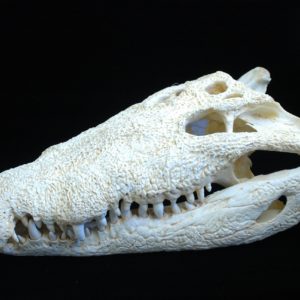
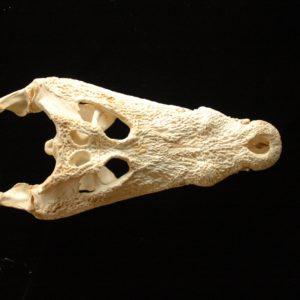
West African Slender-Snouted Crocodile Skull Replica
$360.00
This species is distinguished from other African crocodiles by a snout that completely lacks any bony ridges.
- Description
- Additional information
Description
West African slender-snouted crocodile skull replica measures 16 x 6.5 x 4.5 inches. West African slender-snouted crocodile is museum-quality polyurethane resin cast of original specimen. 2-part skull (separate cranium and jaw). Made in USA.
Mecistops is a genus of crocodiles, the Slender-snouted crocodiles, native to sub-Saharan Africa.
West African slender-snouted crocodile are native to freshwater habitats in central and western Africa. They prefer highly vegetated bodies of water to hide from prey and potential predators.
They are medium-sized crocodiles, typically slightly smaller than the Nile crocodile, but are larger than several other species of crocodilians.
West African slender-snouted crocodile adults are typically about 8.2 ft. long, but have been known to reach 14 ft. They weigh between 276 and 717 lb. Males are significantly larger than females.
They have a slender snout used for catching prey, hence their name. They are incredibly shy and adversely impacted by human disturbance.
The diet of the slender-snouted crocodile consists mainly of fish, amphibians, and crustaceans. Typically, they can be found basking on land. Adults occasionally take smaller mammals, aquatic snakes, turtles, and birds.
Both species in the genus are not typically found in groups, except during the onset of the breeding season. The female slender-snouted crocodile constructs a mound nest consisting mainly of plant matter.
The nests are usually 50 to 60 cm high and 1 to 2 m in diameter. Nests are placed on the banks of rivers, and construction generally begins at the onset of the wet season, although breeding is asynchronous even within members of one population.
The West African slender-snouted crocodile has good hearing, eyesight, and smell. Throughout the body of crocodiles, sensory pits are present, which have nerve terminals inside.
The two types of these sensory pits are integumentary sense organs that cover the body and papillae that cover the head, primarily around the snout.
Scientific classification:
- Kingdom: Animalia
- Phylum: Chordata
- Class: Reptilia
- Clade: Archosauria
- Order: Crocodilia
- Superfamily: Crocodyloidea
- Family: Crocodylidae
- Genus: Mecistops
- Species: M. cataphractus
- Binomial name: Mecistops cataphractus (Cuvier, 1825)
- Temporal range: Miocene – Recent, 11.6–0 Ma
- Conservation status: Critically Endangered (IUCN 3.1)
If you find this replica interesting, you may also like our false gharial crocodile, nile crocodile, or the American crocodile. Shop for more museum-quality replicas in our reptile store.
Additional information
| Weight | 30 lbs |
|---|---|
| Dimensions | 16 × 6.5 × 4.5 in |
| World Crocodile Day - June 17th | June 17 marks World Crocodile Day, an occasion that is dedicated to celebrating and raising awareness about one of the world's most formidable reptiles: the crocodile. This day isn't just for herpetologists or wildlife enthusiasts. It's for everyone. |