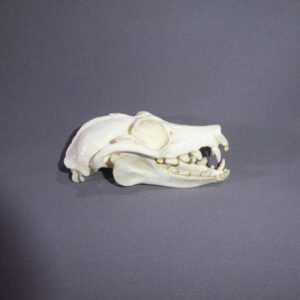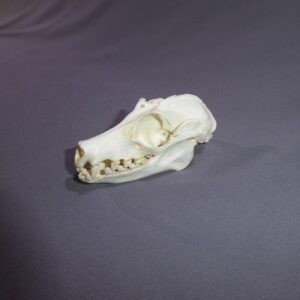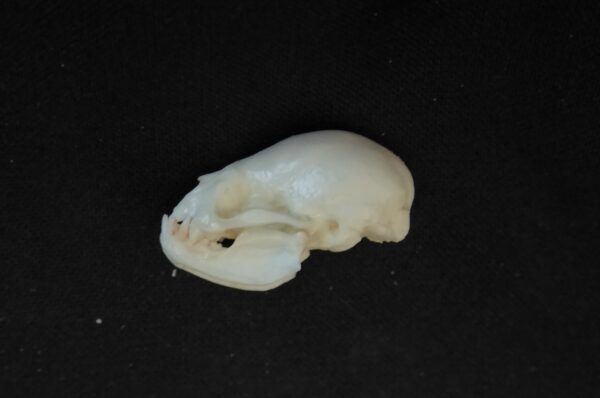
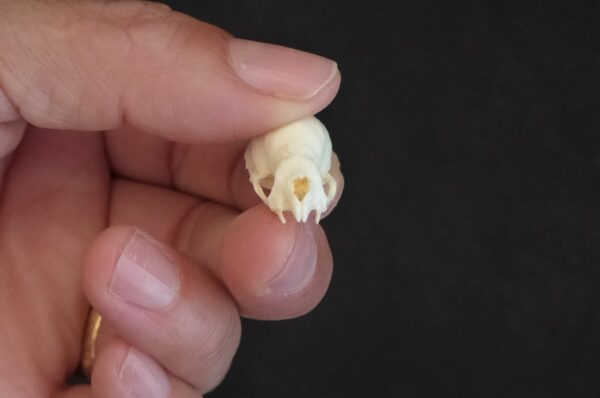

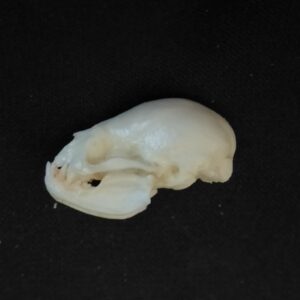
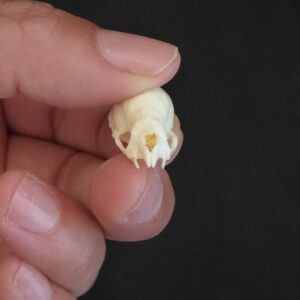
Vampire Bat Skull Replica Cast
$62.00
The Vampire is found in northern Mexico south to Uruguay & as its name suggests, feeds on the blood of other mammals. Feeding occurs when the bat locates sleeping prey, bites a tiny hole with its razor-like incisors, then laps the blood with its tongue.
- Description
- Additional information
Description
Vampire Bat Skull Replica Cast measures 1.0″L x 0.5″W x 0.5″H. Museum quality polyurethane resin cast of original specimen is 2-part skull (separate cranium and jaw). Made in USA. Species name Desmodus rotundus.
Vampire bats, members of the subfamily Desmodontinae, are leaf-nosed bats currently found in Central and South America. Their food source is the blood of other animals, a dietary trait called hematophagy.
Three extant bat species feed solely on blood: the common vampire bat (Desmodus rotundus), the hairy-legged vampire bat (Diphylla ecaudata), and the white-winged vampire bat (Diaemus youngi). Two extinct species of the genus Desmodus have been found in North America.
Vampire bats are in a diverse family of bats that consume many food sources, including nectar, pollen, insects, fruit and meat. The three species of vampire bats are the only mammals that have evolved to feed exclusively on blood (hematophagy) as micropredators, a strategy within parasitism.
Unlike fruit bats, the vampire bats have short, conical muzzles. They also lack a nose leaf, instead having naked pads with U-shaped grooves at the tip.
The common vampire bat, Desmodus rotundus, also has specialized thermoreceptors on its nose, which aid the animal in locating areas where the blood flows close to the skin of its prey. A nucleus has been found in the brain of vampire bats that has a similar position and similar histology to the infrared receptor of infrared-sensing snakes.
A vampire bat has front teeth that are specialized for cutting and the back teeth are much smaller than in other bats. The inferior colliculus, the part of the bat’s brain that processes sound, is well adapted to detecting the regular breathing sounds of sleeping animals that serve as its main food source.
While other bats have almost lost the ability to maneuver on land, vampire bats can walk, jump, and even run by using a unique, bounding gait, in which the forelimbs instead of the hindlimbs are recruited for force production, as the wings are much more powerful than the legs. This ability to run seems to have evolved independently within the bat lineage.
Vampire bats also have a high level of resistance to a group of bloodborne viruses known as endogenous retroviruses, which insert copies of their genetic material into their host’s genome.
Vampire Bat Facts:
Scientific classification
Domain: Eukaryota
Kingdom: Animalia
Phylum: Chordata
Class: Mammalia
Order: Chiroptera
Family: Phyllostomidae
Subfamily: Desmodontinae
Bonaparte, 1845
Binomial name: Desmodus rotundus
Explore our collection of museum-quality anatomical bat skull replica casts designed for chiropterology research.
For a professional anatomical study, compare this specimen with our fruit bat skull replica cast.
This skull specimen enhances research focus when paired with our fruit bat brain replica cast for biology.
Our Vampire Bat skull replica cast is an authentic reproduction that provides a modern anatomical reference to the fossil bat skeleton plaque replica cast.
Additional information
| Weight | 1.5 lbs |
|---|---|
| Dimensions | 1.0 × 0.5 × 0.5 in |