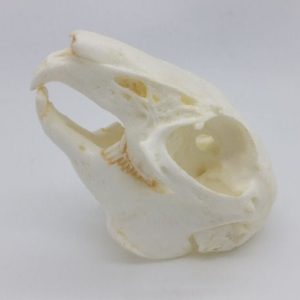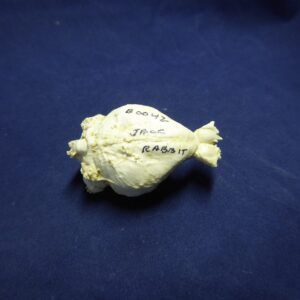


White-tailed Jackrabbit Brain Replica
$26.00
The white-tailed jackrabbit has a brain that supports acute hearing and vision, allowing for high-speed evasion and complex zigzag running patterns.
- Description
- Additional information
Description
White-tailed Jackrabbit Brain Replica for Lagomorph Study
White-tailed jackrabbit brain replica measures 2.0 x 1.2 x 1.1 inches. Lepus townsendii hare brain is museum-quality polyurethane resin cast from CAS specimen. 1:1 scale. Made in USA.
Characteristics of the White-tailed Jackrabbit
The white-tailed jackrabbit is also known as the prairie hare or the white jack. This species of hare lives throughout western North America. Like all hares and rabbits, it belongs to the family Leporidae within the order Lagomorpha.
These animals usually live solitary lives. However, several males will court a single female during the breeding season. Females give birth to litters of four or five young in a shallow ground depression called a form. This jackrabbit has two subspecies. Specifically, one occurs west of the Rocky Mountains while the other lives to the east.
Scientific Classification
- Kingdom: Animalia
- Phylum: Chordata
- Class: Mammalia
- Order: Lagomorpha
- Family: Leporidae
- Genus: Lepus
- Species: Lepus timidus
- Binomial name: Lepus townsendii Bachman, 1839
- Conservation status: Least Concern (IUCN 3.1)
Explore Lagomorph Cranial Development
Integrating a white-tailed jackrabbit skull replica with this brain model offers a complete look at lagomorph anatomy. Furthermore, adding a snowshoe rabbit skull replica and an Eastern cottontail skull replica creates a rare comparison of North American hares and rabbits. This grouping allows you to examine the extreme physical diversity found within the family Leporidae across different habitats.
While the white-tailed jackrabbit represents the large hares of the open plains, the Eastern cottontail provides a fascinating contrast in size and skeletal structure. Consequently, including the snowshoe rabbit skull completes the story by showing how different hare species adapted to forest and winter environments. Therefore, these combined specimens provide a comprehensive look at how diverse lagomorph groups evolved over time.
Additional information
| Weight | 2.0 lbs |
|---|---|
| Dimensions | 2.0 × 1.2 × 1.1 in |