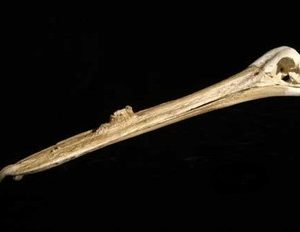
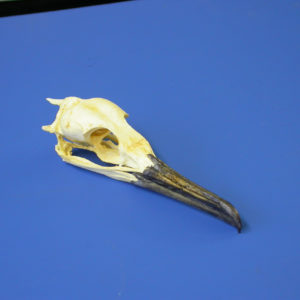
American Crow Skull Replica
$61.00
A 2012 genetic analysis of the genus Corvus calculated that the American crow diverged from a lineage that gave rise to the collared, carrion, and hooded crows around 5 million years ago.
- Description
- Additional information
Description
American Crow Skull Replica Information
American crow skull replica measures 3.6″L. American crow skull replica is museum-quality polyurethane resin cast. 2-part skull (separate cranium and mandibe). Made in USA.
Discription
The American crow is a large passerine bird species of the family Corvidae. It is a common bird found throughout much of North America.
Although the American crow and the hooded crow are very similar in size, structure and behavior, their calls and visual appearance are different.
The American crow is a large, distinctive bird with iridescent black feathers all over.
Its legs, feet and bill are also black. They measure 16 to 21 in. in length, of which the tail makes up about 40%. The wing chord is 9.6 to 13.0 in., with the wingspan ranging from 33 to 39 in.
The bill length can be from 1.2 to 2.2 in. The tarsus is 2.2 to 2.6 in. and the tail is 5.3 to 7.5 in. The body mass can vary from 11.1 to 21.9 oz. Males tend to be larger than females.
From beak to tail, an American crow measures 16 to 20 in., almost half of which it is tail.
Its wingspan is 33 to 39 in. Mass varies from about 11 to 21 oz., with males tending to be larger than females. Plumage is all black, with iridescent feathers. It looks much like other all-black corvids.
Disribution and habitat
The American crow has a large range, extending from the Pacific Ocean to the Atlantic Ocean in Canada, on the French islands of Saint-Pierre and Miquelon, south through the United States, and into northern Mexico.
Vocalization:
The most usual call is a loud, short, and rapid caaw-caaw-caaw. Usually the birds thrust their heads up and down as they utter this call.
American crows can also produce a wide variety of sounds and sometimes mimic noises made by other animals, including other birds, such as barred owls.
Lifespan:
The average lifespan of the American crow in the wild is 7 to 8 years. Captive birds are known to have lived up to 30 years.
Intelligence:
Crows have been noted to be intelligent. They have the same brain-weight-to-body ratio as humans. This has led to some studies that have identified that crows are self-aware and that young crows take time to learn from tolerant parents.
While a human has a neocortex, the crow has a different area in their brain that is equally complex.
Reproducton:
American crows are socially monogamous cooperative breeding birds. Mated pairs form large families of up to 15 individuals from several breeding seasons that remain together for many years.
The nesting season starts early, with some birds incubating eggs by early April. American crows build bulky stick nests, nearly always in trees but sometimes also in large bushes and, very rarely, on the ground. They will nest in a wide variety of trees, including large conifers, although oaks are most often used.
Offspring from a previous nesting season will usually remain with the family to assist in rearing new nestlings. American crows do not reach breeding age for at least two years. Most do not leave the nest to breed for four to five years.
Three to six eggs are laid and incubated for 18 days. The young are usually fledged by about 36 days after hatching. Predation primarily occurs at the nest site and eggs and nestlings are frequently eaten by snakes, raccoons, ravens and domestic cats.
Diet:
American crows are active hunters and will prey on mice, young rabbits, frogs, and other small animals.
The American crow is omnivorous. It will feed on invertebrates of all types, carrion, scraps of human food, fruits, nuts such as walnuts and almonds, seeds, eggs and nestlings, stranded fish on the shore and various grains.
Scientific classification:
Kingdom: Animalia
Phylum: Chordata
Class: Aves
Order: Passeriformes
Family: Corvidae
Genus: Corvus
Species: C. brachyrhynchos
Binomial name: Corvus brachyrhynchos Brehm, 1822
Conservation status: Least Concern (IUCN 3.1) Secure NatureServe
The corvus brachyrhynchos specimen is a classic example of a generalist passerine skull. Its stout, slightly curved beak is a focal point for studies in avian intelligence and adaptive foraging. Compare this specimen with the common raven skull, american white pelican skull, and Brandt’s cormorant female skull. Purchase other museum-quality replicas from our bird or aves replica store.
Additional information
| Weight | 1.5 lbs |
|---|---|
| Dimensions | 3.6 × 1.5 × .3 in |