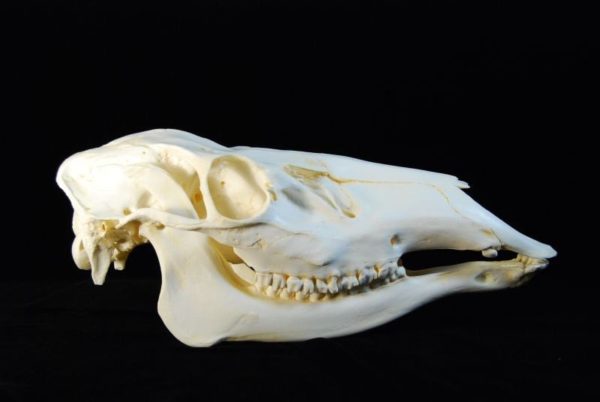
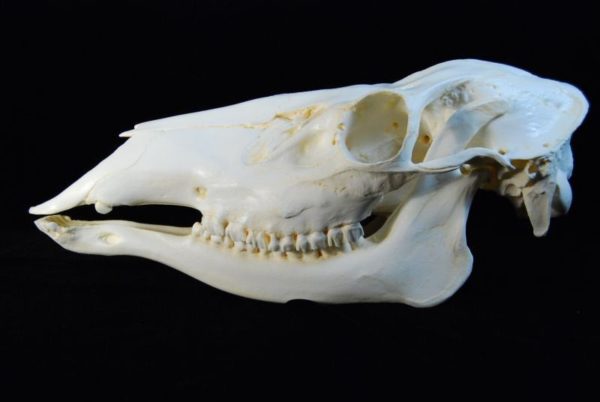
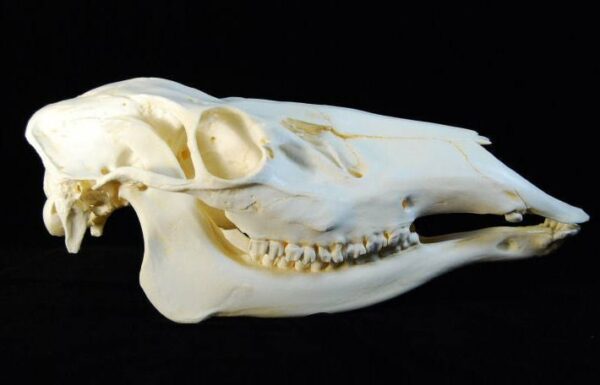


American Elk Skull Replica
$273.00
Males engage in mating behaviors during the mating season, including posturing to attract females, sparring, and bugling, a loud series of throaty whistles, bellows, and screams.
- Description
- Additional information
Description
American elk skull replica measures 17.8″L. American elk skull replica is a museum-quality polyurethane resin cast from California Academy of Sciences specimen. 2-part skull (separate cranium and mandible). 1:1. Made in USA.
The American elk or Cervus canadensis is one of the largest species of the Cervidae or deer family in the world, and one of the largest land mammals in North America and Eastern Asia.
American elk range in color from dark brown in winter to tan in summer and have a characteristic buff colored rump. The head, neck, belly, and legs are darker than both the back and sides.
American elk generally have a long head with large ears and widely branching antlers as long as 1.1 to 1.5 m from tip to tip are found on males only. A dark shaggy mane hangs from the neck to the chest.
With a thick body, short tail and long slender legs, most elk stand approximately 0.75 to 1.5 m high at the shoulder and are 1.6 to 2.7 m from nose to tail.
American elk are social animals; they live in herds with as many as 400 individuals. These herds are matriarchal and are dominated by a single cow.
Seasonal migrations occur with American elk being found at higher elevations during summer, and migrating to lower elevations during winter.
Male elk have large, blood- and nerve-filled antlers, which they routinely shed each year as the weather warms.
As the fall mating season approaches, bulls form harems, which they defend with their large size and aggressive nature.
In spring, the sexes separate; females leave to give birth, while bulls form their own separate herds. After birth, cows and their calves form nursery groups until calves are ready to join the herd. Bulls are only territorial during the mating season and are otherwise not aggressive toward other elk.
American elk are browsers feeding on grasses, sedges, and forbs in summer and woody growth (cedar, wintergreen, eastern hemlock, sumac, jack pine, red maple, staghorn, and basswood) in the winter months.
Favorites of the elk include dandelions, aster, hawkweed, violets, clover, and the occasional mushroom. Elk are ruminant animals and therefore regurgitate their food and remasticate to aid in digestion. This is also known as chewing cud.
Scientific classification:
- Kinngdom: Animalia
- Phylum: Chordata
- Class: Mammalia
- Order: Artiodactyla
- Family: Cervidae
- Subfamily: Cervinae
- Genus: Cervus
- Species: C. canadensis
- Binomial name: Cervus canadensis (Erxleben, 1777)
- Conservation status: Least concern (IUCN 3.1)
The evolutionary pairing with our white-tailed deer skull will help show allomentry amoung closely related Cervidae.
Additional information
| Weight | 14 lbs |
|---|---|
| Dimensions | 17.8 in |