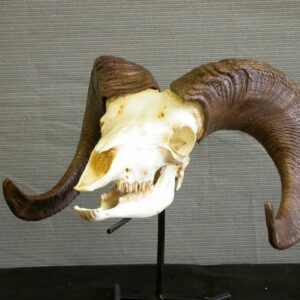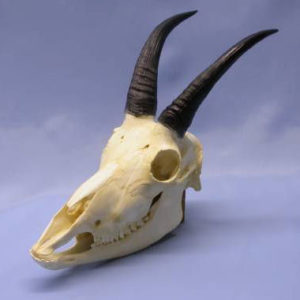
American Mountain Goat Skull Replica
$260.00
The Mountain Goat is found in North America from southern Alaska, throughout much of British Columbia and into northwestern United States.
- Description
- Additional information
Description
American mountain goat skull replica measures 9.8 inches. American mountain goat skull replica is museum-quality polyurethane resin cast from California Academy of Sciences specimen. 2-part skull (separate cranium and mandible). 1:1 scale. Made in USA. Horns measure 7.4 inches.
The American mountain goat is also known as the Rocky Mountain goat, is a hoofed mammal endemic to North America. A sub-alpine to alpine species, it is a sure-footed climber commonly seen on cliffs and ice.
Both Billy (male) and nanny (female) have beards, short tails, and long black horns, 5.9 to 11.0 in. in length, which contain yearly growth rings.
They are protected from the elements by their woolly white double coats. The fine, dense wool of their undercoats is covered by an outer layer of longer, hollow hairs.
American Mountain goats molt in spring by rubbing against rocks and trees, with the adult billies shedding their extra wool first and the pregnant nannies shedding last.
The male stands about 3.3 ft. at the shoulder to the waist and can weigh considerably more than the female. Male goats also have longer horns and longer beards than females.
Scientific Classification
- Kingdom: Animalia
- Phylum: Chordata
- Class: Mammalia
- Order: Artiodactyla
- Family: Bovidae
- Subfamily: Caprinae
- Genus: Oreamnos
- Species: O. americanus
- Binomial name: Oreamnos americanus
- Conservation status: Least concern (IUCN3.1)
Shop more museum-quality goat skulls in our goat skull store.
Additional information
| Weight | 8.0 lbs |
|---|---|
| Dimensions | 9.8 in |
| World Goat Day - August 21st | The World celebrates them on August 21st! Goats have been crucial in our lives for approximately 10,000 years; they are among the first domesticated animals, providing us with food, fertilizer, and clothing. Besides, goats can play an essential role in preventing the spread of noxious weeds and promoting native vegetation through moderate grazing. |