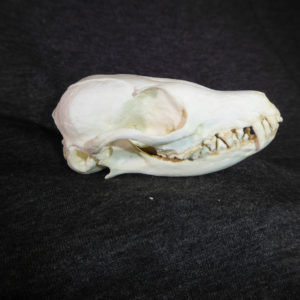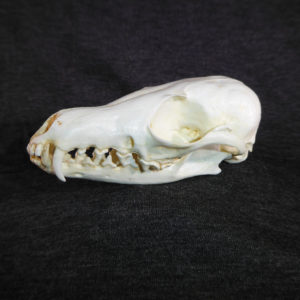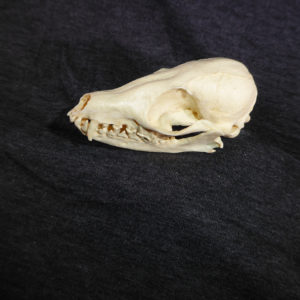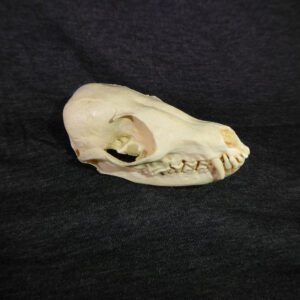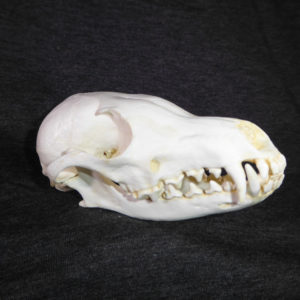

Arctic fox Male Skull Replica
$91.00
Predators of Arctic foxes include large birds of prey, such as bald eagles, golden eagles, hawks, and snowy owls, and carnivorans such as wolves.
- Description
- Additional information
Description
Arctic fox Male Skull Replica Information
Arctic fox male skull replica measures 5.1 inches. Vulpes lagopus male skull is museum-quality polyurethane resin cast from California Academy of Sciences specimen. 2-part skull (separate cranium and mandible). Made in USA.
The Arctic fox or Vulpes lagopus, also known as the white, polar, or snow fox, is a small fox native to the Arctic regions of the Northern Hemisphere and common throughout the Arctic tundra biome.
The Arctic fox or Vulpes lagopus is well adapted to living in cold environments, and is best known for its thick, warm fur that is also used as camouflage. It has a large and very fluffy tail.
Description
The Arctic fox is smaller than the red fox, standing 25–30 cm (9.8–11.8 in) tall at the shoulder.
Males weigh 3.5 kg (7.7 lb) on average, with a range of 3.2–9.4 kg (7.1–20.7 lb), while females average 2.9 kg (6.4 lb), with a range of 1.4–3.2 kg (3.1–7.1 lb).
The average head-to-rear length of males is 55 cm (22 in), ranging from 46–68 cm (18–27 in), while females average 52 cm (20 in) with a range of 41–55 cm (16–22 in). Foxes that live further north are smaller than more southern foxes. The tail is about one third the length of the body.
Diet
Arctic foxes generally eat any small animal they can find, including lemmings, voles, other rodents, hares, birds, eggs, fish, and carrion. They scavenge on carcasses left by larger predators such as wolves and polar bears, and in times of scarcity also eat their feces.
In areas where they are present, lemmings are their most common prey, and a family of foxes can eat dozens of lemmings each day. In some locations in northern Canada, a high seasonal abundance of migrating birds that breed in the area may provide an important food source.
Reproduction
In the spring, the Arctic fox’s attention switches to reproduction and a home for their potential offspring. They live in large dens in frost-free, slightly raised ground.
These are complex systems of tunnels covering as much as 1,000 m2 (11,000 sq ft) and are often in eskers, long ridges of sedimentary material deposited in formerly glaciated regions. These dens may be in existence for many decades and are used by many generations of foxes.
Scientific classification:
- Kingdom: Animalia
- Phylum: Chordata
- Class: Mammalia
- Order: Carnivora
- Family: Canidae
- Genus: Vulpes
- Species: V. lagopus
- Binomial name: Vulpes lagopus (Linnaeus, 1758)
- Conservation status: Least concern (IUCN 3.1)
Complete your exhibit with our high-quality fennec fox skull, pale fox skull, and kit fox skull specimens. Shop for more museum-quality replicas in our fox and wolf replica store.
Additional information
| Weight | 4.5 lbs |
|---|---|
| Dimensions | 5.1 in |
| National Fox Day - September 17th | National Fox Day is celebrated on September 17th by animal lovers and conservationists around the world. The day is a chance to appreciate foxes' role in the environment, correct misconceptions about them, and advocate for their conservation. Foxes are often misunderstood and persecuted, despite their charm, and face threats to their survival from human activities like habitat destruction and hunting. |