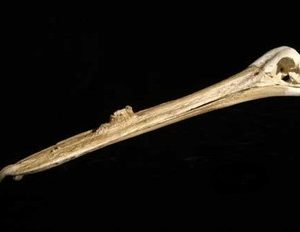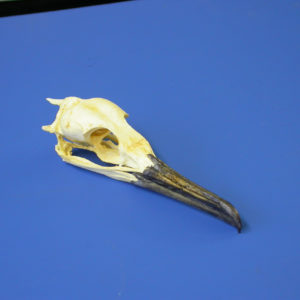
Brandt’s Cormorant Female Skull Replica
$61.00
Brandt’s Cormorant typically live in groups. They breed between March and August, and usually have four eggs. Young birds are cared for by both parents.
- Description
- Additional information
Description
Brandt’s Cormorant Female Skull Replica (Urile penicillatus) Information
Brandt’s cormorant female skull replica measures 5.6 inches. Urile penicillatus skull is museum-quality polyurethane resin cast from California Academy of Sciences specimen. 2-part skull (separate cranium and mandible). 1:1 scale. Made in USA.
Phalacrocoracidae is a family of some 40 species of aquatic birds commonly known as Cormorants and Shags. Cormorants and shags are medium-to-large birds, with body weight in the range of 0.77–11.02 lb. and wing span of 18–39 in. The majority of species have dark feathers.
The Brandt’s Cormorant is a strictly marine bird of the cormorant family of seabirds that inhabits the Pacific coast of North America. It ranges, in the summer, from Alaska to the Gulf of California, but the population north of Vancouver Island migrates south during the winter.
Its specific name, Phalacrocorax penicillatus is Latin for a painter’s brush (pencil of hairs), in reference to white plumes on its neck and back during the early breeding season.
The common name honors the German naturalist Johann Friedrich von Brandt of the Academy of Sciences at St. Petersburg, who described the species from specimens collected on expeditions to the Pacific during the early 19th century.
Brandt’s cormorants feed either singly or in flocks, and are adaptable in prey choice and undersea habitat.
It feeds on small fish from the surface to sea floor, obtaining them, like all cormorants, by pursuit diving using its feet for propulsion. Prey is often what is most common: in central California, rockfish from the genus Sebastes is the most commonly taken, but off British Columbia, it is Pacific herring. Brandts cormorants or Urile penicillatus have been observed foraging at depths of over 120 feet .
During the breeding season, adult Brandt’s cormorants have a blue throat patch. This species nests on the ground or on rocky outcroppings.
Scientific Classification:
Kingdom: Animalia
Phylum: Chordata
Class: Aves
Order: Suliformes
Family: Phalacrocoracidae
Genus: Urile
Species: U. penicillatus
Binomial name: Urile penicillatus (Brandt, 1837)
Conservation status: Least concern (IUCN 3.1)
This urile penicillatus specimen showcases the slender, hooked beak of a specialized marine diver. Study the cranial morphology of this Pacific coast species alongside the American white pelican, brown pelican, and the black skimmer. Locate more marine avian casts in our bird or aves replica store.
Additional information
| Weight | 2.0 lbs |
|---|---|
| Dimensions | 5.6 in |