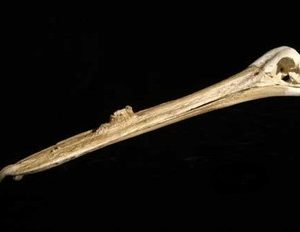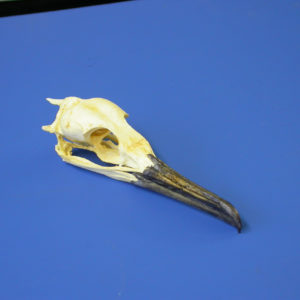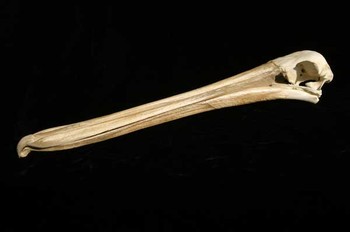

Brown Pelican Skull Replica
$182.00
Brown Pelicans, named for their dark-brownish chest plumage, are a large bird native to the Atlantic, Gulf and Pacific coasts of North America. Pelicans use their long beaks and wide throat pouch to gulp various fish species.
- Description
- Additional information
Description
Brown Pelican Skull Replica (Pelecanus occidentalis) Information
Brown pelican skull replica measures 16.6 x 2.5 x 2.5 inches. Pelecanus occidentalis skull is museum-quality polyurethane resin cast from California Academy of Sciences specimen. 2-part skull (separate cranium and jaw). 1:1. Made in USA.
The brown pelican is a North American bird of the pelican family, Pelecanidae. It is one of three pelican species found in the Americas and one of two that feed by diving in water.
It is found on the Atlantic Coast from Nova Scotia to the mouth of the Amazon River, and along the Pacific Coast from British Columbia to northern Chile, including the Galapagos Islands.
The nominate subspecies in its breeding plumage has a white head with a yellowish wash on the crown. The nape and neck are dark maroon brown.
The upper sides of the neck have white lines along the base of the gular pouch, and the lower fore neck has a pale yellowish patch. The male and female are similar, but the female is slightly smaller.
The brown pelican is the smallest of the nine pelican species, but is often one of the larger seabirds in their range nonetheless. It measures 3 ft 3 in to 5 ft in. in length and has a wingspan of 6 ft 8 in to 7 ft 6 in. The weight of adults can range from 4.4 to 11.0 lb.
The brown pelican mainly feeds on fish, but occasionally eats amphibians, crustaceans, and the eggs and nestlings of birds.
It nests in colonies in secluded areas, often on islands, vegetated land among sand dunes, thickets of shrubs and trees, and mangroves.
Female Pelecanus occidentalis lay two or three oval, chalky white eggs. Incubation takes 28 to 30 days with both sexes sharing duties.
The newly hatched chicks are pink, turning gray or black within 4 to 14 days. About 63 days are needed for chicks to fledge.
Six to 9 weeks after hatching, the juveniles leave the nest, and gather into small groups known as pods.
Scientific Classification
Kingdom: Animalia
Phylum: Chordata
Class: Aves
Order: Pelecaniformes
Family: Pelecanidae
Genus: Pelecanus
Species: P. occidentalis
Binomial name: Pelecanus occidentalis Linnaeus, 1766
Conservation status: Least concern (IUCN 3.1)
This pelecanus occidentalis cast displays the long, hooked beak and distal mandibular flexibility typical of plunge-divers. It is an excellent specimen for marine biology and functional morphology studies. Coordinate with the American white pelican, Brandt’s cormorant female skull, and the California condor skeleton. Source more authentic replicas through our bird or aves replica store.
Additional information
| Weight | 30 lbs |
|---|---|
| Dimensions | 16.6 × 2.5 × 2.5 in |