
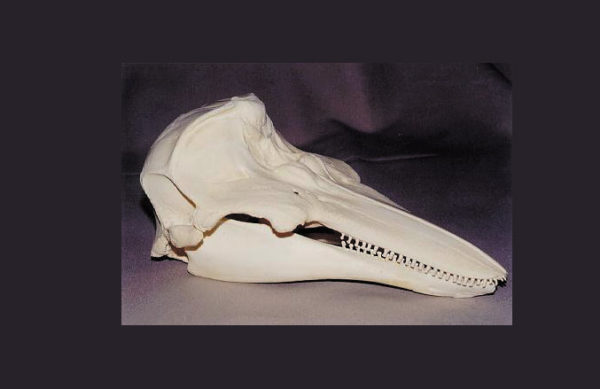

Common Harbour Porpoise Skull Replica
$363.00
Compact, blunt rostrum housing 26 pairs of spade-shaped teeth in the upper jaw and 26 pairs in the lower jaw. The cranium exhibits marked directional asymmetry near the bony nares and contains small, laterally oriented eye orbits.
- Description
- Additional information
Description
Common Harbour Porpoise Skull Replica measures 12.2 inches. Common harbour porpoise skull replica is museum-quality polyurethane resin cast of original specimen. 2-part skull (separate cranium & mandible). Made in USA.
The Common harbour porpoise or Phocoena phocoena is one of six species of porpoise. It is one of the smallest marine mammals. As its name implies, it stays close to coastal areas or river estuaries, and as such, is the most familiar porpoise to whale watchers.
This porpoise often ventures up rivers, and has been seen hundreds of miles from the sea.
The common harbour porpoise is a little smaller than the other porpoises, at about 26 to 33 in. long at birth. Adults of both sexes grow to 4.6 to 6.2 ft. The females are heavier, with a maximum weight of around 168 lb. compared with the males at 134 lb.
The body is robust, and the animal is at its maximum girth just in front of its triangular dorsal fin. The beak is poorly demarcated. The flippers, dorsal fin, tail fin and back are a dark grey. The sides are a slightly speckled, lighter grey. The underside is much whiter, though there are usually grey stripes running along the throat from the underside of the body.
Many anomalously white colored common harbour porpoise have been confirmed, mostly in the North Atlantic, but also notably around Turkish and British coasts, and in the Wadden Sea, Bay of Fundy and around the coast of Cornwall.
Although conjoined twins are rarely seen in wild mammals, the first known case of a two-headed harbour porpoise was documented in May 2017 when Dutch fishermen in the North Sea caught them by chance.
The Common harbour porpoise species is sometimes known as the common porpoise in texts originating in the United Kingdom. In parts of Atlantic Canada known colloquially as the puffing pig, and in Norway ‘nise’, derived from an Old Norse word for sneeze; both of which refer to the sound made when porpoises surface to breathe.
Scientific Classification:
- Domain: Eukaryota
- Kingdom: Animalia
- Phylum: Chordata
- Class: Mammalia
- Order: Artiodactyla
- Infraorder: Cetacea
- Family: Phocoenidae
- Genus: Phocoena
- Species: P. phocoena
- Scientific name: Phocoena phocoena (Linnaeus, 1758)
- Conservation status: Least Concern (IUCN 3.1)
To better understand the biodiversity of our coastal waters, compare this specimen with the short-beaked common dolphin skull, highlighting the distinct anatomical transition from porpoise to dolphin.
Additional information
| Weight | 12 lbs |
|---|---|
| Dimensions | 12.2 in |
| National Dolphin Day - April 14th | While there isn't a national porpoise day, there is a National Dolphin Day on April 14th that celebrates dolphins, which are cetacean mammals that include porpoises. |