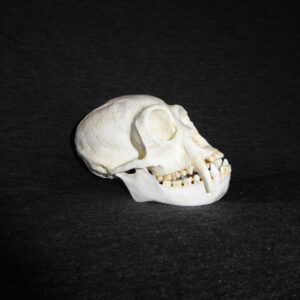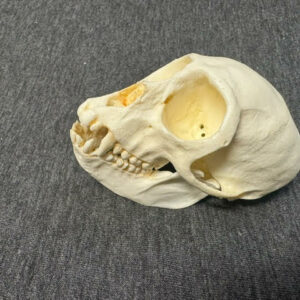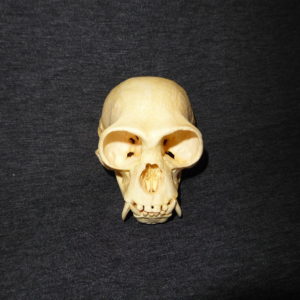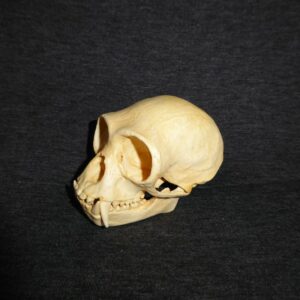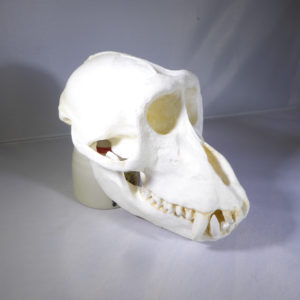


Crab-eating Macaque Monkey Skull Replcia
$182.00
Nasal incisor bone does not suture with the frontal bone. The cavity features two unbranched, dorsoventrally stacked turbinates and very large sinuses.
- Description
- Additional information
Description
Crab-eating macaque monkey skull replica measures 3.9 x 2.4 x 2.5 inches. Macaca fascicularis skull is a museum-quality polyurethane resin cast from California Academy of Sciences specimen. Two-part skull (separate cranium and mandible). 1:1 scale. Made in USA.
This species features a robust cranial vault and prominent, relatively narrow muzzle. A key diagnostic feature of this Old World primate is the complete postorbital closure, providing a solid bony wall that separates the forward-facing orbits from the temporal fossa. The interorbital region is notably narrow compared to other macaque species.
The skull exhibits a classic Old World 2.1.2.3 dental pattern, totaling 32 teeth. This specimen features prominent sloping upper canines with a distinct anterior groove and a strong mandibular structure designed for processing a diverse, opportunistic diet including fruit, seeds and crustaceans.
Scientific Classification
- Kingdom: Animalia
- Phylum: Chordata
- Class: Mammalia
- Order: Primates
- Suborder: Haplorhini
- Infraorder: Simiiformes
- Family: Cercopithecidae
- Genus: Macaca
- Species: M. fascicularis
- Binomial name: Macaca fascicularis Raffles, 1821
- Conservation status: Endangered
The crab-eating macaque skull provides an excellent study of the specialized skull architecture of adaptive, coastal-dwelling Old World monkeys.
Furthermore, for those seeking to chart the diverse evolutionary paths of the cercopithcine branch. Consequently, collectors often showcase this specimen alongside the white-handed gibbon skull replica, the western hoolock gibbon skull replica and the vervet monkey skull replica.
Together, these replicas supply the necessary visual orbital positioning and dental configurations present across different African groups.
Additional information
| Weight | 3.0 lbs |
|---|---|
| Dimensions | 3.9 × 2.4 × 2.5 in |
| International Monkey Day - December 14th | International Monkey Day has been created to celebrate monkeys on December 14th, as well as “all things simian,” which includes lemurs, tarsiers, apes, and other non-human primates. It is a great day when it comes to raising awareness about different types of monkeys and primates around the world, as well as the issues they face and how we can help them. |