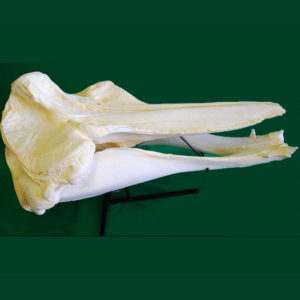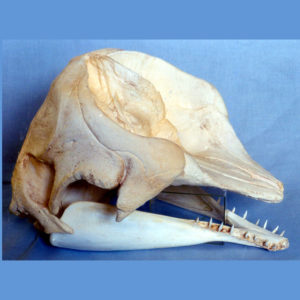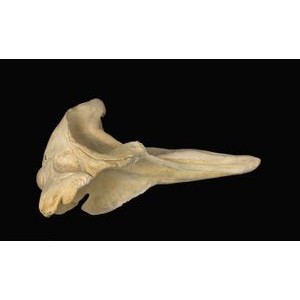
Cuvier’s Beaked Whale Skull Replica
$1,200.00
Cuvier’s beaked whales hunt deep-sea squid like Histioteuthidae and Cranchiidae. Discover their unique suction feeding habits and diverse oceanic prey.
- Description
- Additional information
Description
Cuvier’s beaked whale skull replica measures 37.4″L x 19.5″W x 16.5″H. Museum-grade polyurethane resin cast from California Academy of Sciences specimen: CAS MAM 23214; Ziphius cavirostris; Adult male; Field #RTB 1064; 18 May 1980; Asilomar State Beach, Monterey County, California. 2-part skull (separate cranium and mandible) 1:1 scale (life-size). Made in USA.
Cuvier’s beaked whale skull replica Dimensions
- Length: 37.4 inches (95 cm)
- Width: 19.5 inches (49.5 cm)
- Height: 16.5 inches (42 cm)
- 1:1 scale (life-size)
Cuvier’s beaked whale skull replica Product Details
- Material: Durable polyurethane resin cast.
- Components: 2-part skull (separate cranium and mandible).
- Replicates the massive, deeply ossified rostrum and the characteristic prenarial basin found in adult males of this species.
- This specific male specimen was collected following a stranding at Asilomar State Beach.
Weight Specifications
- Replica Weight (Net): 22.0 lbs (10.0 kg)
- Shipping Weight (Gross): 35.0 lbs (15.9 kg)
The Anatomy of Cuvier’s beaked whale
Cuvier’s beaked whale is a master of the deep ocean. The California Academy of Sciences maintains specimens that showcase the extraordinary skeletal adaptations required for life in the bathypelagic zone. Below are the unique features of this record breaking diver.
- The Pachyostotic RostrumIn mature males such as the CAS specimen, the mesorostral canal is entirely filled with solid bone. This pachyostotic bone is incredibly thick and non porous. It stands as one of the densest biological materials known.
- Erupted Battle TeethThe skull features two prominent forward pointing conical teeth at the tip of the lower jaw. In this species these teeth only erupt in adult males. Rather than aiding in feeding they are used for intraspecific competition which is often referred to as raking. Conversely these teeth remain permanently embedded beneath the gum line in females.
- The Prenarial BasinThe facial region of the skull exhibits a deeply recessed prenarial basin known as the synvertex located in front of the blowhole. This sexually dimorphic trait acts as a structural cradle for the melon. This fatty organ allows the whale to focus high intensity sound waves for echolocation. This ability is essential for hunting in the pitch black depths.
- Extreme Deep Sea AdaptationsThe extreme density of the skull is a vital structural adaptation. It helps the whale withstand the immense hydrostatic pressure of the deep ocean. Cuvier’s beaked whales currently hold the record for the deepest recorded dive of any mammal. They reach depths of approximately 9816 feet or 2992 meters.
- The Goose Beak ProfileThe cranium reveals an upturned mouthline and a blunt sloping forehead. This unique shape creates a profile that researchers historically compared to a goose beak. This distinct silhouette eventually provided the species with its common name.
Scientific classification:
- Domain: Eukaryota
- Kingdom: Animalia
- Phylum: Chordata
- Class: Mammalia
- Order: Artiodactyla
- Infraorder: Cetacea
- Family: Monodontidae
- Genus: Delphinapterus
- Lacépède, 1804
- Species: D. leucas
- Binomial name: Delphinapterus leucas
- Conservation status: Least Concern
Pair this Cuvier’s beaked whale skull specimen with our Cuvier’s beaked whale tooth replicas.
The Cuvier’s beaked whale skull replica is an authentic, 1:1 scale (life-size) reproduction molded from specimen: CAS MAM 23214; Ziphius cavirostris; Male; Field #RTB 1064; 18 May 1980; Asilomar State Beach, Monterey County, California.
Additional information
| Weight | 35 lbs |
|---|---|
| Dimensions | 37.4 × 19.5 × 16.5 in |