
Grallator Dinosaur Footprint Fossil Replica
$21.00
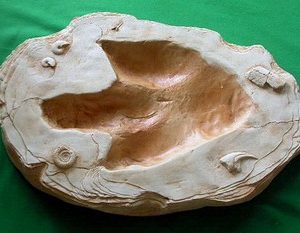
Grallator or Hunanpus footprints are characteristically three toed and range from 4 to 8 in. long. Though the tracks show only three toes, the trackmakers likely had between four and five toes on their feet.
- Description
- Additional information
Description
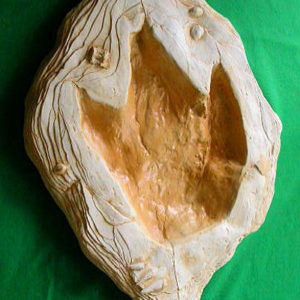
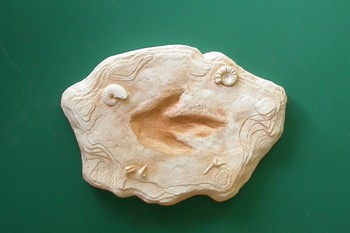
Grallator dinosaur footprint fossil replica measures 7.0″L x 4.0″W x 1.5″H. Imprint size is 2.5″L x 4.0″W. Grallator dinosaur footprint fossil replica is museum-quality polyurethane resin cast of original specimen. Made in USA.
Grallator or Grallator cursorius is an ichnogenus (form taxon based on footprints) which covers a common type of small, three toed print made by a variety of bipedal theropod dinosaurs. Grallator type footprints have been found in formations dating from the Early Triassic through to the early Cretaceous periods.
They are found in the United States, Canada, Europe, Australia, Brazil (Sousa and Santa Maria Formations) and China, but are most abundant on the east coast of North America, especially the Triassic and Early Jurassic formations of the northern part of the Newark Supergroup.
The name grallator translates into “stilt walker”, although the actual length and form of the trackmaking legs varied by species, usually unidentified. The related term “Grallae” is an ancient name for the presumed group of long legged wading birds, such as storks and herons. These footprints were given this name by their discoverer, Edward Hitchcock, in 1858.
Grallator footprints are characteristically three toed and range from 4 to 8 in. long. Though the tracks show only three toes, the trackmakers likely had between four and five toes on their feet.
While it is usually impossible to match these prints with the exact dinosaur species that left them, it is sometimes possible to narrow down potential trackmakers by comparing the proportions in individual grallator with known dinosaurs of the same formation. For example, grallator tracks identified from the Yixian Formation may have been left by caudipteryx.
These footprints were likely made by an unidentified, primitive dinosaur similar to coelophysis. The Newark Supergroup footprints show digits II, III and IV, but no trace of the shorter digits I and V which would likely have been present in a dinosaur of this stage.
The outer two digits would have been stubby and ineffective, not touching the ground during walking or running. Despite losing most of their effectiveness, dinosaur evolution had not yet removed these digits to fully streamline the foot.
Trace fossil classification:
- Domain: Eukaryota
- Kingdom: Animalia
- Phylum: Chordata
- Clade: Dinosauria
- Clade: Saurischia
- Clade: Theropoda
- Ichnofamily: †Grallatoridae
- Ichnogenus: †Grallator
- Type ichnospecies: †Grallator cursorius Hitchcock, 1858
- Temporal range: Early Triassic-Early Cretaceous ~250–100 Ma
Shop More Museum Quality Dinosaur Fossils in Dinosaur Fossil Store
Additional information
| Weight | 3.0 lbs |
|---|---|
| Dimensions | 7.0 × 4.0 × 1.5 in |
| National Dinosaur Day - June 1st | National Dinosaur Day is celebrated on June 1st every year. It's a day to learn about dinosaurs, including what they looked like, what they ate, and how they became extinct. |