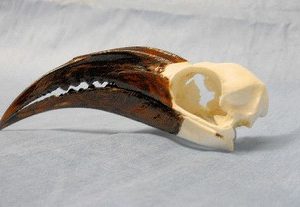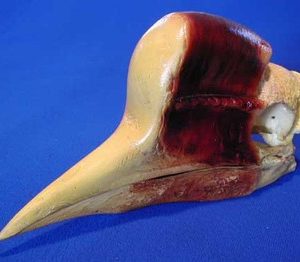
Helmeted Hornbill Skull Replica
$151.00
The Helmeted Hornbill was once heavily hunted for its “horn” which was carved for religious ceremonies. The female hornbill uses mud to seal herself in a hollowed tree during nesting, allowing a small opening for her mate to bring her food.
- Description
- Additional information
Description
Helmeted Hornbill Skull Replica measures 8.3L x 2.2W x 4.3H in. Helmeted Hornbill Skull Replica is museum quality polyurethane resin cast of original specimen. 2-part skull (separate cranium and jaw). Made in USA.
The Helmeted hornbill or Rhinoplax vigil is a very large bird in the hornbill family. The casque goes from the base of the bill halfway to the tip, where it ends abruptly.
It and the bill are yellow; the red secretion of the preen gland covers the sides, top of the casque and the base of the bill.
This species has a bare, wrinkled throat patch, pale blue to greenish in females and red in males. The Helmeted hornbill or Rhinoplax vigil casque is solid, and the skull including the casque and bill may constitute 10 percent of the bird’s weight.
It has mostly blackish plumage, except that the belly and legs are white and the tail is white with a black band near the tip of each feather.
The tail is long and the two central tail feathers are much longer than the others, giving the bird a total length greater than that of any other hornbill species. The body length is 43 to 47 in.
Rhinoplax vigil call is a series of loud, intermittent barbet like hoots, sometimes double toned and over two dozen in number, which gradually accelerates to culminate in a cackle reminiscent of laughter.
Rhinoplax vigil eats mostly fruit, especially figs. It may also use the casque as a weighted tool to dig into rotten wood and loose bark in search of insects and similar prey.
Unlike many fruit-eating hornbills, the Rhinoplax vigil is sedentary, and pairs maintain a territory. Males fight over territory on the wing, ramming each other with their casques.
The casque of the or Rhinoplax vigil is the source of hornbill ivory, a valuable carving material. Indigenous peoples also use the central tail feathers to decorate dancing cloaks and head-dresses.
Helmeted Hornbill Scientific Facts:
Kingdom: Animalia
Phylum: Chordata
Class: Aves
Order: Bucerotiformes
Family: Bucerotidae
Genus: Rhinoplax
Species: R. vigil
Binomial name: Rhinoplax vigil
Conservation status: Critically Endangered
Compare the massive, solid density of this casque to the White-Thighed Hornbill male skull replica to observe the radical evolutionary shift toward lighter, ridge-based cranial structures.
Additional information
| Weight | 4.0 lbs |
|---|---|
| Dimensions | 8.3 × 2.75 × 5.5 in |