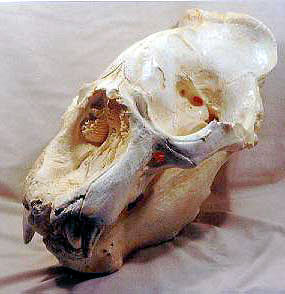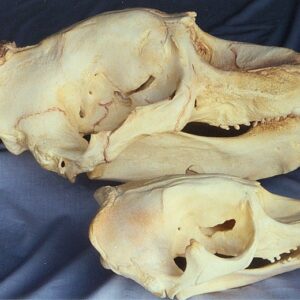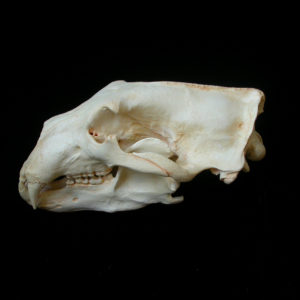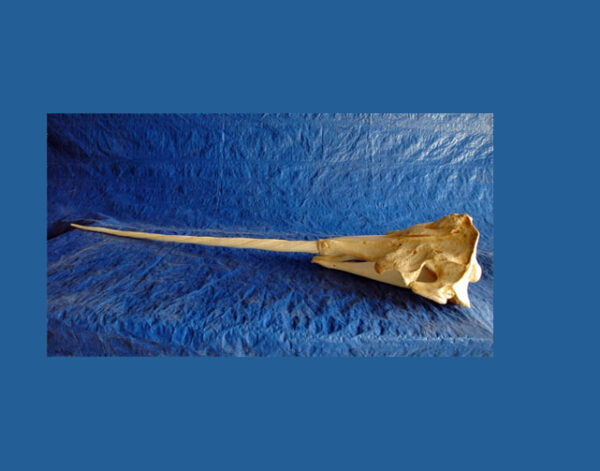
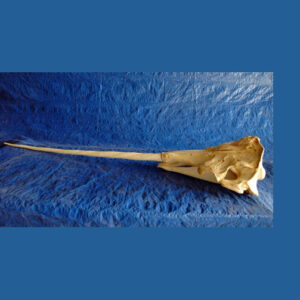
Narwhal Male Skull & Tusk Replica Cast
$1,021.00
The Narwhal (Monodon monoceros), is a species of toothed whale. It is a member of the family Monodontidae, and the only species in the genus Monodon. An adult male’s long single tusk that can be up to 3 m (9.8 feet).
- Description
- Additional information
Description
Narwhal Male Skull & Tusk replica cast measures 22.0″L x 16.0″W x 12.0″H. Tusk measures 61.0″L x 2.25″W at base. Skull & Tusk replicas are museum-quality polyurethane resin cast of original specimens from SDNHM & CAS. 2-part (separate cranium & mandible). Scale 1:1 (Life Size), Made in USA.
Narwhal or Monodon monoceros are medium-sized whales typically weighing within a range from 1,760 to 3,530 lb.
The pigmentation of Narwhal or Monodon monoceros is a mottled pattern, with blackish-brown markings over a white background. They are darkest when born and become whiter with age.
The most conspicuous characteristic of the male narwhal or Monodon monoceros is a single long tusk, a canine tooth that projects from the left side of the upper jaw, through the lip, and forms a left-handed helix spiral.
The tusk grows throughout life, reaching a length of about 1.5 4.9 to 10.2 ft. It is hollow and weighs around 22 lb. About one in 500 males has two tusks, occurring when the right canine also grows out through the lip. Only about 15 percent of female Narwhal or Monodon monoceros grow a tusk. It lives year-round in the Arctic waters around Greenland, Canada, and Russia.
Old males may be almost pure white. Narwhal or Monodon monoceros do not have a dorsal fin, possibly an evolutionary adaptation to swimming easily under ice. Their neck vertebrae are jointed, like those of land mammals, instead of being fused together as in most whales, allowing a great range of neck flexibility.
Both these characteristics are shared by the beluga whale. The tail flukes of female narwhals or Monodon monoceros have front edges that are swept back, and those of males have front edges that are more concave and lack a sweep-back. This is thought to be an adaptation for reducing drag caused by the tusk.
The Narwhal or Monodon monoceros tusks are surrounded posteriorly, ventrally, and laterally by several small vestigial teeth which vary in morphology and histology. These teeth can sometimes be extruded from the bone, but mainly reside inside open tooth sockets in the narwhal’s snout alongside the tusks.
Narwhal Facts:
Kingdom: Animalia
Phylum: Chordata
Class: Mammalia
Order: Artiodactyla
Infraorder: Cetacea
Family: Monodontidae
Genus: Monodon
Species: M. monoceros
Binomial name: Monodon monoceros
Conservation status: Least concern
Navigate our comprehensive vault of whale skeleton and bone replica casts specifically curated for advanced marine biology research.
This Monodontidae specimen provides a fascinating structural comparison to the bulbous cranium of our beluga whale skull replica cast.
For a study of diverse apex odontocete structures, contrast this skull with our killer whale skull replica cast.
This narwhal male skull replica cast is a masterful, Scale 1:1 reproduction molded from a San Diego Natural History Museum original specimen.
The narwhal male tusk replica cast is a masterful, Scale 1:1 reproduction molded from a California Academy of Sciences original specimen.
Additional information
| Weight | 40 lbs |
|---|---|
| Dimensions | 20.0 × 16.0 × 12.0 in |
| World Whale Day - 3rd Sunday of February | World Whale Day is celebrated on the third Sunday of February each year to recognize whales and raise awareness of the threats they face. The day began in Maui, Hawaii in 1980 to honor the humpback whales that migrate to the islands each winter to give birth. The Pacific Whale Foundation organizes events that include parades, activities for children, and fun characters. |