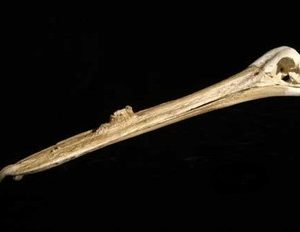
Roseate Spoonbill Skull Replica
$120.00
The Roseate Spoonbill feeds in shallow fresh or coastal waters by swinging its bill from side to side as it steadily walks through the water, often in groups. The bird feeds on crustaceans, bits of plant material, aquatic insects, mollusks, frogs, newts and very small fish, such as minnows.
- Description
- Additional information
Description
Roseate spoonbill skull replica measures 8.6″L. Roseate spoonbill skull replica is museum-quality polyurethane resin cast from California Academy of Sciences specimen. 2-part skull (separate cranium & mandible). 1:1 scale. Made in USA.
Discription:
Roseate spoonbills are medium-sized waterbirds with a football-shaped body and long legs. The long bill that is flattened into a spoon at the end protrudes from their small head.
They fly with their long necks outstretched and often rest with it curled into an S shape.
Both sexes of these waterbirds weigh from 42.3 to 63.5 ounces. Their wingspan is 47.2 to 51.2 inches and their length is 27.9 to 33.9 inches.
These waterbirds are pale pink birds with brighter pink shoulders and rump. They have a white neck and a partially feathered, yellowish green head from which their red eyes shine.
Juveniles are paler pink and have a completely feathered head for 3 years until they attain adult breeding plumage.
Distribution:
In the United States, the species is locally common in Texas, Florida, and southwest Louisiana. Generally, the species occurs in South America mostly east of the Andes, and in coastal regions of the Caribbean, Central America, Mexico, and the Gulf Coast of the United States, and from central Florida’s Atlantic coast at Merritt Island National Wildlife Refuge, adjoined with NASA Kennedy Space Center at least as far north as South Carolina’s Myrtle Beach.
Behavior:
Little is known about the roseate spoonbill’s behavior outside of their foraging habits. This species feeds in shallow fresh or coastal waters by swinging its bill from side to side as it steadily walks through the water, often in groups. Moreover, the spoon-shaped bill allows it to sift easily through mud.
Breeding:
The roseate spoonbill nests in shrubs or trees, often mangroves, laying two to five eggs, which are whitish with brown markings.
The chicks hatch with a downy cover, eyes open and able to walk, however they tend to stay in the nest.
Nestlings are sometimes killed by turkey vultures, bald eagles, raccoons and invasive fire ants.
Diet:
The bird feeds on crustaceans, bits of plant material, aquatic insects, mollusks, frogs, newts and minnows.
In Brazil, researchers found roseate spoonbill diets to consist of fish, insects, crustaceans, mollusks, and seeds.
Roseate spoonbills must compete for food with other freshwater birds, such as snowy egrets, great egrets, tricolored herons and American white pelicans.
Scientific classification:
- Kingdom: Animalia
- Phylum: Chordata
- Class: Aves
- Order: Pelecaniformes
- Family: Threskiornithidae
- Genus: Platalea
- Species: P. ajaja
- Binomial name: Platalea ajaja Linnaeus, 1758
- Conservation status: Least concern (IUCN 3.0)
With the spatulate roseate spoonbill skull replica you can find another masterclass in avian evolution with the uniquely boat-billed heron skull replica featuring a broad, scoop-like bill for ambush hunting.
Shop more Bird Skull Replicas in Bird or Aves Skull Store
Additional information
| Weight | 6.0 lbs |
|---|---|
| Dimensions | 8.6 in |