

Sperm Whale Fossil Tooth Replica
$34.00
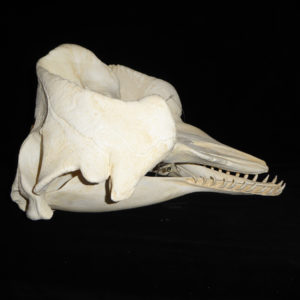
Sperm whales have conical teeth on their long, narrow, lower jaw. The teeth fit neatly into sockets in the upper jaw, which has no teeth. This arrangement is a perfect adaptation for slurping up soft-bodied squids.
- Description
- Additional information
Description
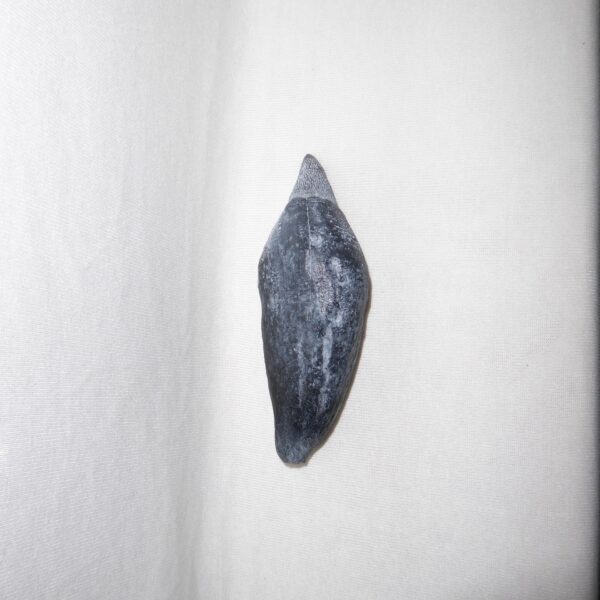
Sperm Whale Fossil Tooth measures Replica 6.5″L. Fossil Tooth from Miocene period is museum-quality polyurethane resin cast of original specimen. Made in USA.
The Sperm Whale or Physeter macrocephalus is the largest of the toothed whales and the largest toothed predator. The Sperm Whales unique body is unlikely to be confused with any other species.
The Sperm Whales distinctive shape comes from its very large, block-shaped head, which can be one quarter to one third of the animal’s length. The S-shaped blowhole is located very close to the front of the head and shifted to the whale’s left.
The Sperm Whale or Physeter macrocephalus is a pelagic mammal with a worldwide range, and will migrate seasonally for feeding and breeding. Females and young males live together in groups, while mature males (bulls) live solitary lives outside of the mating season. The females cooperate to protect and nurse their young.
Females give birth every four to 20 years, and care for the calves for more than a decade. A mature Sperm Whale or Physeter macrocephalus has few natural predators, although calves and weakened adults are sometimes killed by pods of Killer whales.
Mature Sperm Whale or Physeter macrocephalus males average 52 feet in length but some may reach 68 feet, with the head representing up to one-third of the animal’s length. Plunging to 7,382 feet, it is the second deepest diving mammal, exceeded only by Cuvier’s beaked whale.
Sperm whales have conical teeth on their long, narrow, lower jaw. The teeth fit neatly into sockets in the upper jaw, which has no teeth. This arrangement is a perfect adaptation for slurping up soft-bodied squids.
The Sperm Whale uses echolocation and vocalization as loud as 230 decibels underwater. Sperm Whale or Physeter macrocephalus has the largest brain on Earth, more than five times heavier than a human’s. Sperm whale or Physeter macrocephalus can live 70 years or more.
Spermaceti (sperm oil), from which the whale derives its name, was a prime target of the whaling industry, and was sought after for use in oil lamps, lubricants, and candles. Ambergris, a solid waxy waste product sometimes present in its digestive system, is still highly valued as a fixative in perfumes, among other uses.
Beachcombers look out for ambergris as flotsam. Sperm whaling was a major industry in the 19th century, depicted in the novel Moby-Dick. The species is protected by the International Whaling Commission moratorium.
Sperm Whale Facts:
Temporal range: Pliocene – Recent
Conservation status: Vulnerable
Scientific classification
Domain: Eukaryota
Kingdom: Animalia
Phylum: Chordata
Class: Mammalia
Order: Artiodactyla
Infraorder: Cetacea
Family: Physeteridae
Genus: Physeter
Species: P. macrocephalus
Binomial name: Physeter macrocephalus
Contrast the massive, peg-like structure of this prehistoric dental specimen with the formidable apex predatory jaw of our mosasaurus skull.
Analyze the divergence of specialized cetacean dentition by pairing this fossil tooth with the legendary spiral of our narwhal male tusk.
To showcase the ultimate study in aquatic killing mechanisms, contrast this fossilized bone with the serrated power of our great white shark jaw.
Additional information
| Weight | 5.4 lbs |
|---|---|
| Dimensions | 6.5 in |