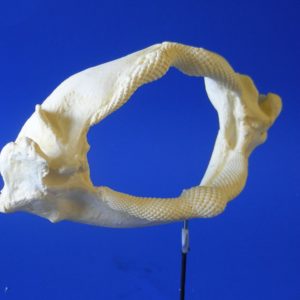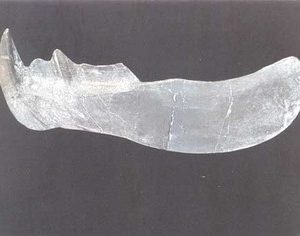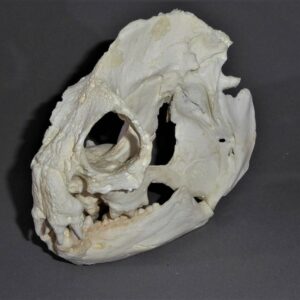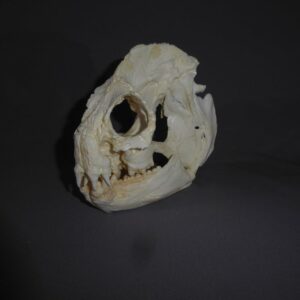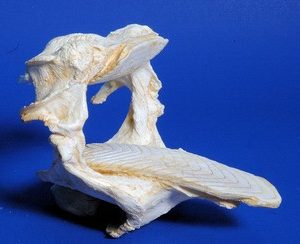
Spotted Eagle Ray Jaw Replica
$90.00
The Spotted Eagle Ray Shark, also called the Bowmouth Guitarfish, is an unmistakable specimen with its extremely broad and blunt head, clearly demarcated from its pectoral fins, and its long tail.
- Description
- Additional information
Description
Spotted Eagle Ray Skull Replica: Museum-Grade Marine Specimen
This Spotted Eagle Ray jaw replica is a museum-grade polyurethane resin cast of an original specimen. Measuring 5.0L x 4.0W x 4.3H inches, this high-fidelity model is proudly Made in USA. It represents the chondrocranium (cartilaginous skull) and specialized dentition of the Aetobatus narinari.
Anatomical Features of the Spotted Eagle Ray Skull Replica
The Spotted Eagle Ray jaw replica captures the distinct adaptations of one of the ocean’s most recognizable cartilaginous fish. Key features include:
- Cartilage (Skull): Unlike bony fish, the skull is made of cartilage. The replica displays the broad, shovel-shaped, or duck-like, rostral cartilage.
- Crushing Plates (Jaw Plates): Features a single row of broad, flat teeth fused into solid upper and lower plates (calcified jaw plates) used for crushing shelled prey.
Rostrum:The snout is elongated and rigid, designed for digging into the benthic sediment to locate prey. - Orbital Structure: Large lateral, overhanging “eyebrow” ridges (supraorbital ridges) are prominent, housing the eyes on the sides of the head.
- Spiracle Location: Large openings located directly behind the eye, used for breathing while resting on the sea floor.
Biological Context and Feeding Behavior
In the wild, the ray uses its strong Spotted Eagle Ray jaw replica structure to eat clams and crabs. Furthermore, the specialized mouth helps the animal break hard shells. After crushing the shell, the ray uses tiny bumps in its mouth to find the meat. These rays live in warm tropical waters and coastal reefs.
Educational and Display Applications
Teachers and collectors often choose this Spotted Eagle Ray jaw replica for several reasons. Specifically, it works well for:
- Marine Biology Education: Demonstrating cartilaginous fish anatomy.
- Museum & Aquarium Display: Showcasing biodiversity in coastal ecosystems.
- Private Collections: A high-detail piece for shark, ray, or prehistoric anatomy enthusiasts.
Scientific Classification:
- Kingdom: Animalia
- Phylum: Chordata
- Class: Chondrichthyes
- Superorder: Batoidea
- Order: Myliobatiformes
- Family: Myliobatidae
- Genus: Aetobatus
- Species: A. narinari
- Binomial name: Aetobatus narinari (Euphrasén, 1790)
- Conservation Status: Near Threatened
Compare the cartilaginous structure of this ray with the heavily calcified wolf eel skull to see how two completely different lineages of fish evolved massive jaw muscles to dominate the same rocky reef niches.
Additional information
| Weight | 5 lbs |
|---|---|
| Dimensions | 5.0 × 4.0 × 4.3 in |