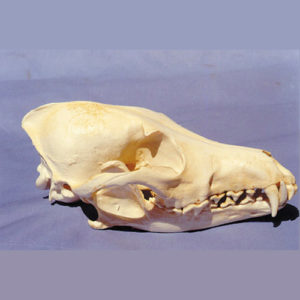
White-tailed Female Deer Skull Replica
$151.00
In North America, the white-tailed deer is very common (even considered a nuisance in some areas) in states to the east and south of the Rocky Mountains, including southwestern Arizona.
- Description
- Additional information
Description
White-tailed female deer skull replica measures 10.0″L. White-tailed female deer skull replica is museum-quality polyurethane resin cast. 2-part skull (separate cranium and mandibe). Made in USA.
The white-tailed deer head and body length is 150 to 200 cm, tail length is 10 to 28 cm, and height at the shoulders is between 80 and 100 cm.
The white-tailed deer dorsal coloration differs in shading locally, seasonally, and among subspecies; however in general it is grayer in the winter and redder in the summer.
White fur is located in a band behind the nose, in circles around the eyes, inside the ears, over the chin and throat, on the upper insides of the legs and beneath the tail.
The white-tailed deer have scent glands between the two parts of the hoof on all four feet, metatarsal glands on the outside of each hind leg, and a larger tarsal gland on the inside of each hind leg at the hock.
Scent from these glands is used for intraspecies communication and secretions become especially strong during the rutting season.
White-tailed deer males possess antlers which are shed from January to March and grow out again in April or May, losing their velvet in August or September.
At birth, fawns are spotted with white in coloration and weight between 1.5 and 2.5 kg. Their coats become grayish lose their spots by their first winter. White-tailed deer have good eyesight and acute hearing, but depend mainly on their sense of smell to detect danger.
Odocoileus virginianus feed on a variety of vegetation, depending on what is available in their habitat. In eastern forests, buds and twigs of maple, sassafras, poplar, aspen and birch are consumed, as well as many shrubs.
In desert areas, plants such as Huajillo brush, yucca, prickly pear cactus, comal, ratama and various tough shrubs may be the main components of a whitetail deer diet. Conifers are often utilized in winter when other foods are scarce.
White-tailed deer are crepuscular, feeding mainly from before dawn until several hours after, and again from late afternoon until dusk.
Scientific classification:
- Kingdom: Animalia
- Phylum: Chordata
- Class: Mammalia
- Order: Artiodactyla
- Family: Cervidae
- Subfamily: Capreolinae
- Genus: Odocoileus
- Species: O. virginianus
- Binomial name: Odocoileus virginianus
- Conservation status: Least concern
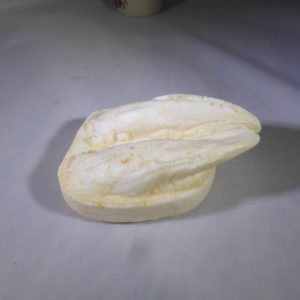
White-tailed deer skull creates an osteological paring with the white-tailed deer brain replica.
Additional information
| Weight | 14 lbs |
|---|---|
| Dimensions | 10 in |
| International White Tail Deer Day - December 13th | International White-Tailed Deer Day is celebrated on December 13th. Wildtree also hosts an annual Whitetail World Field Day, which in 2024 was held on Saturday, March 9th at the Institute for Whitetail Deer Management & Research Facility. |