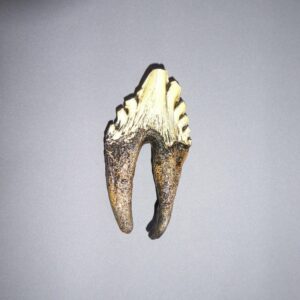
Beluga Whale Ear Bone Replica
$79.00
The Beluga whale is adapted to life in the Arctic, with anatomical and physiological characteristics that differentiate it from other cetaceans. Amongst these are its all-white color and the absence of a dorsal fin, which allows it to swim under ice with ease.
- Description
- Additional information
Description
Beluga whale ear bone replicas are museum-quality polyurethane resin casts from specimen: CAS MAM 10165; Delphinapterus leucas; Male; Field #B.M.M. 12; 29 June 1954; Naknek River, Bristol Bay, Alaska, USA. 1:1 scale (Life size), Made in USA.
Produt dimensions (Replica CA10165)
The ear bone assembly in cetaceans is comprised of two distinct, dense parts: the Tympanic Bulla and the Periotic. The measurements for these museum-quality casts are as follows:
Tympanic Bulla:
- Length: 1.5 inches (3.8 cm)
- Width: 1.1 inches (2.8 cm)
- Height: 0.8 inches (2.0 cm)
Periotic Bone:
- Length: 1.3 inches (3.3 cm)
- Width: 0.9 inches (2.3 cm)
- Height: 0.6 inches (1.5 cm)
Beluga whale ear bone replicas product details:
- Scale: 1:1 (Life-size).
- Material: High-density polyurethane resin (cast to mimic the weight and “stony” density of the original bone).
- Anatomy: Includes the auditory bulla (the shell-like structure) and the periotic (the portion housing the inner ear).
- Origin: The original specimen was collected from a mature male in the Naknek River, a key habitat for the Bristol Bay beluga population.
Beluga whales have a highly developed sense of hearing, with a range of 1.2–120 kHz, and are most sensitive to sounds between 10–75 kHz. This is much wider than the human range of 0.02–20 kHz. Belugas use their hearing for many purposes, including communication and echolocation.
Beluga whale tympanic bullae are dense, protective ear bones that house the middle and inner ear, crucial for their underwater hearing by channeling sound vibrations from the jaw (via fat bodies) to the cochlea, allowing them to “see” with sound through echolocation in dark, icy Arctic waters.
These bowl-shaped structures are rich in calcium, making them dense and excellent for fossilization, and function like an eardrum but aren’t the eardrum itself, amplifying sound for the brain.
Belugas are known as the “canaries of the sea” because they have a large repertoire of sounds, including whistles, squeals, moos, chirps, and clicks. They do not have vocal cords, so these sounds come from their blowholes, which have two air sacs that can be manipulated to create different pitches.
Beluga whales emit a series of clicks to find food called echolocation or sonar and it is the use of sound waves to determine the location of objects.
Many animals have this ability, including bats, whales, dolphins, shrews, and some birds. These animals send out sound waves that echo back to them to locate prey and for navigation. These clicks bounce off objects in their environment and echo back to the whale, which processes the information to determine the size, shape, speed, distance, and even some internal structure of objects in the water.
The melon at the front of the whale’s head acts like an acoustical lens to focus the sound waves into a beam that’s projected forward. Belugas receive the sounds through the fat-filled canals in their lower jawbones, which then conduct them to the middle ear, inner ear, and finally to the hearing centers in the brain.
Scientific classification:
Domain: Eukaryota
Kingdom: Animalia
Phylum: Chordata
Class: Mammalia
Order: Artiodactyla
Infraorder: Cetacea
Family: Monodontidae
Genus: Delphinapterus
Lacépède, 1804
Species: D. leucas
Binomial name: Delphinapterus leucas
Conservation status: Least Concern
This unique ear bone is a fascinating anatomical addition to our beluga whale skull replica cast.
The Beluga whale ear bone replicas are authentic, 1:1 scale (Life size) reproductions molded from CAS MAM 10165; Delphinapterus leucas; Male; Field #B.M.M. 12; 29 June 1954; Naknek River, Bristol Bay, Alaska, USA.
Additional information
| Weight | 4.0 lbs |
|---|---|
| Dimensions | 3.5 × 2.5 × 1.5 in |
You may also like…
-


Beluga Whale Articulated Skeleton Replica
Price range: $8,800.00 through $9,450.00Select options This product has multiple variants. The options may be chosen on the product pageQuick View -

-