

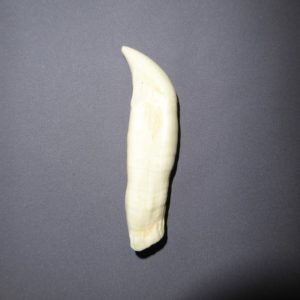
Killer Whale Tooth Replica Cast Replica
$14.00
Killer Whales teeth are very strong, and its jaws exert a powerful grip; the upper teeth fall into the gaps between the lower teeth when the mouth is closed.
- Description
- Additional information
Description
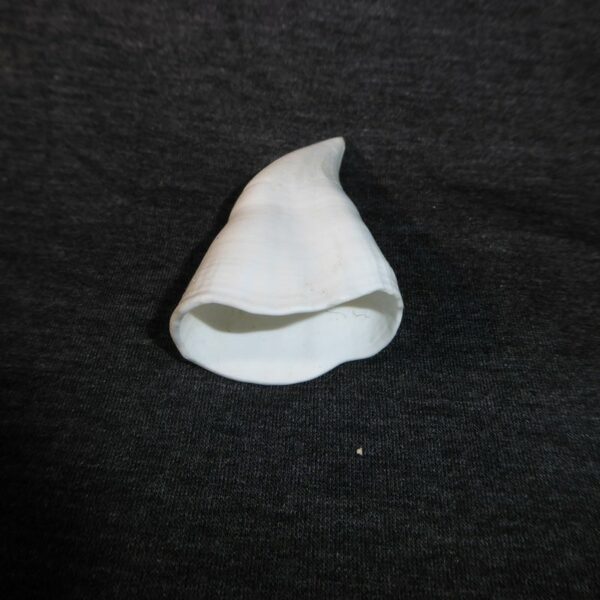
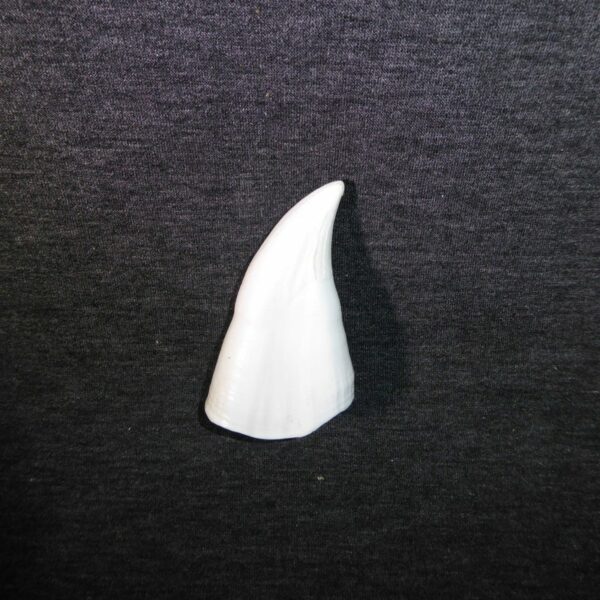
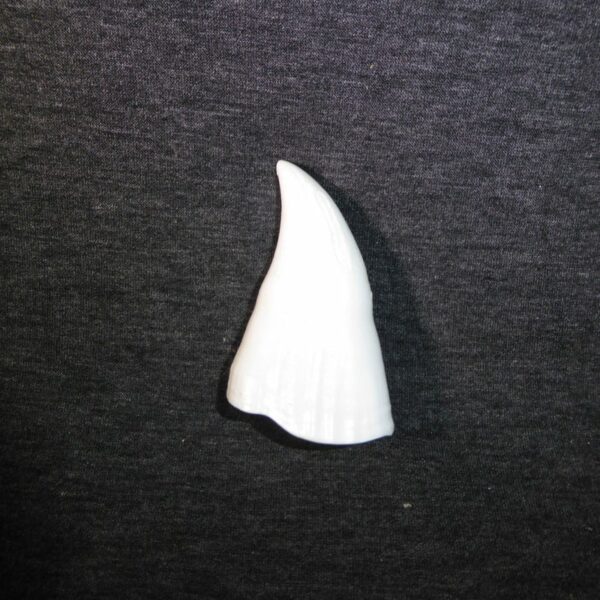
Killer Whale Tooth cast replica measures 0.236″L. Killer whale tooth is museum-quality polyurethane resin cast of original specimen. Made in USA. Tooth replica is the top of the tooth and is hollow.
The Killer Whale or Orcinus orca, also referred to as the Orca whale or Orca, and less commonly as the Blackfish or Grampus.
Killer Whale or Orcinus orca have a black back, white chest and sides, and a white patch above and behind the eye.
It has a heavy and robust body with a large dorsal fin up to 5.9 ft. tall. Behind the fin, it has a dark grey saddle patch across the back.
Killer Whale or Orcinus orca teeth are very strong, and its jaws exert a powerful grip; the upper teeth fall into the gaps between the lower teeth when the mouth is closed. The firm middle and back teeth hold prey in place, while the front teeth are inclined slightly forward and outward to protect them from powerful jerking movements.
Killer Whale or Orcinus orca are the largest extant members of the dolphin family. Males typically range from 20 to 26 ft. long and weigh in excess of 6 tons.
Females are smaller, generally ranging from 16 to 23 ft. and weighing about 3 to 4 tons. Calves at birth weigh about 400 lb. and are about 7.9 ft. long. Calves are born with a yellowish or orange tint, which fades to white.
The Killer Whale or Orcinus orca large size and strength make it among the fastest marine mammals, able to reach speeds in excess of 34 mph.
Killer Whale or Orcinus orca are apex predators, meaning that they themselves have no natural predators. They are sometimes called the wolves of the sea, because they hunt in groups like wolf packs.
Killer Whales hunt varied prey including fish, cephalopods, mammals, sea birds, and sea turtles. Other marine mammal prey species include nearly 20 species of seal, sea lion and fur seal. Walruses and sea otters are less frequently taken.
Killer Whale Facts:
Kingdom: Animalia
Phylum: Chordata
Class: Mammalia
Order: Artiodactyla
Infraorder: Cetacea
Family: Delphinidae
Genus: Orcinus
Species: O. orca
Binomial name: Orcinus orca
We provide an elite selection of museum-grade whale skeleton and bone replica casts designed for rigorous comparative anatomy.
This individual dental specimen is an essential addition when paired with our robust killer whale skull replica cast.
Gain a broader perspective on cetacean dentition by comparing this tooth with our museum-quality narwhal skull replica cast.
Additional information
| Weight | 1 lbs |
|---|---|
| Dimensions | 0.236 in |
| World Whale Day - 3rd Sunday of February | World Whale Day is celebrated on the third Sunday of February each year to recognize whales and raise awareness of the threats they face. The day began in Maui, Hawaii in 1980 to honor the humpback whales that migrate to the islands each winter to give birth. The Pacific Whale Foundation organizes events that include parades, activities for children, and fun characters. |
| Size | Males: 20-26 ft (6-8 m), up to 22,000 lbs (10,000 kg), Females: 16-23 ft (5-7 m), weighing 3-4 tons (3.3-4.4 short tons). Calves: Around 7.5 ft (2.4 m) long, 400 lbs (180 kg) at birth. |
| Range | Killer whales (orcas) are found in every ocean globally, from Arctic ice to tropical seas, making them the most widespread marine mammal. All Oceans: From the Arctic to the Antarctic, Indian, Atlantic, and Pacific. |
| Distinguishing Featuers | Bold black-and-white patterns, featuring a white belly, white eye patch, and unique gray "saddle patch" behind the dorsal fin, and a towering triangular dorsal fin (especially in males). |
You may also like…
-

-


Killer Whale Skull Replica
Price range: $1,300.00 through $1,650.00Select options This product has multiple variants. The options may be chosen on the product pageQuick View -