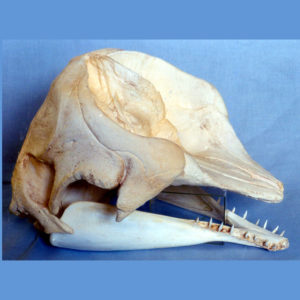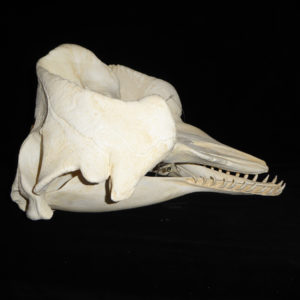

Pygmy Sperm Whale Skull Replica Cast Replica
$756.00
Pygmy sperm whale skull replica is a museum-grade 1:1 scale reproduction of an adult male Kogia breviceps specimen. This durable polyurethane cast features the species’ distinct cranial asymmetry and deeply recessed spermaceti basin.
- Description
- Additional information
Description
Pygmy Sperm Whale Skull Replica cast measures 17.3″L x 15.6″W x 11.2″H. Museum-quality polyurethane resin cast from Santa Barbara Museum of Natural History specimen. SBMNH 1419; Field #K-79-10; Adult male; 25 June 1979; Leadbetter Beach, Santa Barbara, California. 2-part skull (separate cranium and mandible). Scale 1:1 – Made in USA.
Pygmy sperm whale skull replica Dimensions
- Length: 17.3 inches (44 cm)
- Width: 15.6 inches (39.6 cm)
- Height: 11.2 inches (28.5 cm)
- Scale: 1:1 scale (life-size)
- Replica Weight (Net): 13.0 lbs (5.9 kg)
- Shipping Weight (Gross): 30.0 lbs (13.6 kg)
Pygmy sperm whale skull replica Product Details
- Material: Durable polyurethane resin cast.
- Components: 2-part skull (separate cranium and mandible).
- Features: Replicates the short, broad, and markedly asymmetrical cranium with a deeply bowl-shaped prenarial basin.
- Teeth Count: 13 pairs of long, curved, needle-like teeth in the lower jaw; the upper jaw lacks functional teeth and features sockets to accommodate the lower teeth.
- Origin: This specific adult male specimen was collected following a stranding at Leadbetter Beach.
The Anatomy of Pygmy sperm whale
The Pygmy sperm whale is a mysterious deep-ocean inhabitant with skeletal adaptations for life in the mesopelagic zone. These adaptations are clearly demonstrated by specimens held at the Santa Barbara Museum of Natural History. Specifically, the following features define this specimen.
Cranial Asymmetry
- First, the Pygmy sperm whale exhibits extreme cranial asymmetry, much like its larger relative. Consequently, the left bony naris is significantly larger than the right. This structural difference is likely linked to complex nasal passages used for both breathing and echolocation.
The Spermaceti Basin
- Additionally, the front of the skull is deeply concave. This forms a “bowl” that houses the spermaceti organ and melon. These organs are vital because they assist with buoyancy and focus sound waves. Interestingly, this basin is more prominent in Kogia species relative to skull size than in most other cetaceans.
Shark-like Mandible
- Furthermore, the lower jaw is small and subterminal. This gives the mouth a shark-like appearance from below. This specific specimen possesses 13 pairs of sharp, needle-like teeth exclusively in the lower jaw. These teeth fit into corresponding sockets located in the smooth upper jaw.
Deep Sea Foraging Adaptations
- Because the skull is structured for suction feeding, the whale can pull in prey like squid and crustaceans by rapidly expanding its throat. Moreover, the absence of functional upper teeth allows the long, curved lower teeth to secure slippery prey effectively.
The “Ink” Defense
- Finally, Pygmy sperm whales have a specialized sac. This sac expels a cloud of reddish-brown liquid to confuse predators. As a result, the whale can escape into deeper water safely.
Scientific classification:
- Domain: Eukaryota
- Kingdom: Animalia
- Phylum: Chordata
- Class: Mammalia
- Order: Artiodactyla
- Infraorder: Cetacea
- Family: Kogiidae
- Genus: Kogia
- Species: K. breviceps
- Binomial name: Kogia breviceps
- Conservation status: Data Deficient
This cranial specimen provides an anatomical contrast to the acoustics-focused rostrum of our beluga whale skull.
For a sophisticated analysis of deep-diving cranial evolution, pair this specimen with our elephant seal male skull.
Molded from SBMNH original specimen, our pygmy sperm whale skull provides an authentic look at this unique species.
To provide a comprehensive anatomical study of this rare cetacean, the Pygmy Sperm Whale flipper replica can be paired with our Pygmy Sperm Whale Skull to illustrate the full skeletal morphology of the species. This combination allows researchers and educators to examine the specialized cranial structures alongside the unique pentadactyl limb architecture characteristic of these deep diving odontocetes.
Additional information
| Weight | 30 lbs |
|---|---|
| Dimensions | 17.3 × 15.6 × 11.2 in |
| Size | Length: Adults generally 2.7–3.8m (9-12.5 ft), Weight: Adults up to 408–450 kg (900–1000 lbs), Newborns: About 1.2m (4 ft) long. |
| Range | Global Distribution: Found in all major oceans (Atlantic, Pacific, Indian). |
| Distinguishing Features | Small, dolphin-like body. Large, bulbous head. Hooked dorsal fin. "False gill" (whitish mark) behind each eye. |