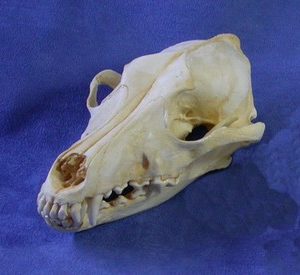
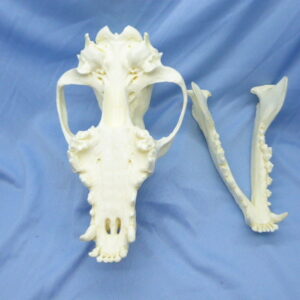
Canis hallstromi Skull replica is museum quality polyurethane cast. Canis hallstromi Skull replica is 2-part skull (separate cranium and jaw). Known as the Singing Dog.
The New Guinea singing dog or Canis hallstromi dog is an ancient (basal) lineage of dog found in the New Guinea Highlands, on the island of New Guinea.
Once considered to be a separate species in its own right, under the name Canis hallstromi, it is closely related to the Australian dingo. The Hallstrom’s Dog is relatively unusual among canines; it is one of the few to be considered “barkless” (hence its common name of “singing dog”), and known for its unusual “yodel”-like style of vocalizing.
The Canis hallstromi skull is wedge-shaped, with a broad top and a narrow muzzle. The skull is in proportion to the rest of the dog’s body and is wedge-shaped, with a broad top and narrow muzzle. A slight median furrow runs from the stop, disappearing towards the occiput. The upper first molar, called a carnassial tooth is quite large.
The head is clean-cut and without excess skin or wrinkles. Their eyes are small, triangular in shape, and feature several shades of brown. Their ears are small, triangular and set wide apart.
New Guinea singing dogs are known for their unique vocalizations, especially their howl. They are very athletic and can jump high into the air. They also are excelletn climbers and diggers.
The limbs and spine of the Canis hallstromi are very flexible and they can spread their legs sideways to 90°, comparable to the Norwegian Lundehund. They can also rotate their front and hind paws more than domestic dogs, which enables them to climb trees with thick bark or branches that can be reached from the ground.
The eyes, which are highly reflective, are triangular (or almond-shaped) and are angled upwards from the inner to outer corners with dark eye rims. Eye color ranges from dark amber to dark brown.
Their eyes exhibit a bright green glow when lights are shone on them in low light conditions. There are two features which researchers believe allow New Guinea singing dogs to see more clearly in low light.
One is that of their pupils, which open wider and allow in more light than in other dog varieties. The other is that they possess a higher concentration of cells in the tapetum.
Canis hallstromi dogs have erect, pointed, fur-lined ears. As with other wild dogs, the ears ‘perk,’ or lay forward, which is suspected to be an important survival feature for the form. The ears can be rotated like a directional receiver to pick up faint sounds. Their tails are bushy, long enough to reach the hock, free of kinks, and have a white tip.
Pups are born with a dark chocolate brown pelt with gold flecks and reddish tinges, which changes to light brown by the age of six weeks. Adult coloration occurs around four months of age.
For adult dogs, the colors brown, black, and tan have been reported, all with white points. The sides of the neck and zonal stripes behind the scapula are golden. Black and very dark guard hair is generally lightly allocated over the hair of the spine, concentrating on the back of the ears and the surface of the tail over the white tip.
The muzzle is always black on young dogs. Generally, all colors have white markings underneath the chin, on the paws, chest and tail tip. About one third also have white markings on the muzzle, face and neck. By 7 years of age, the black muzzle begins to turn grey.