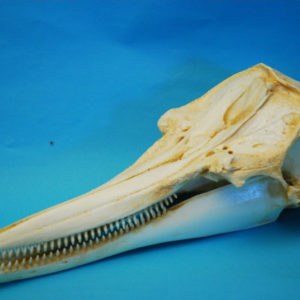
S. Fluviatilis Skull Replica measures 12.9 inches. S. Fluviatilis Skull Replica is museum quality polyurethane resin cast, 2-part skull (separate cranium and jaw). Made in USA. Cast of an original California Academy of Sciences specimen. Known as Tucuxi Gray River Dolphin.
The S. Fluviatilis or Tucuxi Gray River Dolphin, is a species of freshwater dolphin found in the rivers of the Amazon basin.
The S. Fluviatilis is frequently described as looking similar to the Bottlenose dolphin, but it is typically smaller at around 4.9 feet. The dolphin is colored light to bluish grey on its back and sides.
They are quite active and may jump clear of the water (a behavior known as breaching), somersault, spy-hop or tail-splash. They are unlikely, however, to approach boats.
The S. Fluviatilis skull of Tucuxi Gray River Dolphin typically measures around 12.9 inches in length and has a moderate length beak. Their teeth are uniform in size and shape and are perfect to grab slippery fish. They have 26 to 36 pairs of teeth in each jaw.
S. Fluviatilis or Tucuxi Gray River Dolphin forage in tight groups, often chasing fish in rapid dashes just below the water surface, with fish jumping out of their way. Thirty species of fish are known to be prey, some living in protected lakes and channels, while others occur in fast-flowing rivers.
A significant human problem is fishing nets for the S. Fluviatilis or Tucuxi’s Gray River Dolphin. Deliberate hunting in the Amazon basin for food has also been reported.
The S. Fluviatilis or Tucuxi’s Gray River Dolphin habitat has been greatly affected by anthropogenic activities including the expansion of hydroelectric projects, which usually results in isolation where a dam is built.
Pollution, in particular, mercury poisoning of water due to gold mining, is a major concern for this species.
The IUCN also cites habitat fragmentation by dam construction as a threat to S. Fluviatilis, though more detailed study is necessary.