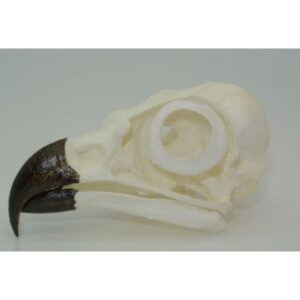
Sea Hawk Skull Replica or Osprey Bird Skull measures 3.3 inches. Sea Hawk Skull is museum quality polyurethane resin cast made in the USA. 2-part skull (separate cranium & jaw). Made in USA.
The Sea Hawk or Osprey also called River Hawk, and Fish Hawk, is a diurnal, fish-eating bird of prey with a cosmopolitan range.
It is a large raptor, reaching more than 24 in. in length and 71 in. across the wings. It is brown on the upperparts and predominantly greyish on the head and underparts.
The Sea Hawk or Osprey tolerates a wide variety of habitats, nesting in any location near a body of water providing an adequate food supply.
It is found on all continents except Antarctica, although in South America it occurs only as a non-breeding migrant.
The Osprey breeds near freshwater lakes and rivers, and sometimes on coastal brackish waters. Rocky outcrops just offshore are used in Rottnest Island off the coast of Western Australia, where there are 14 or so similar nesting sites of which five to seven are used in any one year.
Ospreys usually mate for life. Rarely, polyandry has been recorded. The breeding season varies according to latitude: spring (September–October) in southern Australia, April to July in northern Australia, and winter (June–August) in southern Queensland.
In spring the pair begins a five-month period of partnership to raise their young. The female lays two to four eggs within a month and relies on the size of the nest to conserve heat.
The Sea Hawk or Osprey eggs are whitish with bold splotches of reddish-brown and are about 2.4 in × 1.8 in. and weigh about 2.3 oz. The eggs are incubated for about 35 to 43 days to hatching.The newly hatched chicks weigh only 1.8–2.1 oz., but fledge in 8 to 10 weeks.
The Sea Hawk or Osprey is piscivorous, with fish making up 99% of its diet. It typically takes live fish weighing 5.3–10.6 oz. and about 9.8–13.8 in. in length, but virtually any type of fish from 1.8 oz. to 4.4 lb. can be taken.
Sea Hawk or Ospreys have a vision that is well adapted to detecting underwater objects from the air. Prey is first sighted when the osprey is 33–131 feet above the water, after which the bird hovers momentarily and then plunges feet first into the water.
The Osprey has a large range, covering 3,730,000 sq mi. in just Africa and the Americas, and has a large global population estimated at 460,000 individuals.
The female Osprey lays two to four eggs within a month and relies on the size of the nest to conserve heat. The eggs are whitish with bold splotches of reddish-brown and are incubated for about 35 to 43 days to hatching.
Although global population trends have not been quantified, the species is not believed to approach the thresholds for the population decline criterion of the IUCN Red List, and for these reasons, the species is evaluated as Least Concern.
There is evidence for regional decline in South Australia where former territories at locations in the Spencer Gulf and along the lower Murray River have been vacant for decades.
In the late 19th and early 20th centuries, the main threats to the Sea Hawk or Osprey populations were egg collectors and hunting of the adults along with other birds of prey.
Osprey populations declined drastically in many areas in the 1950s and 1960s; this appeared to be in part due to the toxic effects of insecticides such as DDT on reproduction.
The pesticide interfered with the Sea Hawk or Osprey’s calcium metabolism which resulted in thin-shelled, easily broken or infertile eggs.
Possibly because of the banning of DDT in many countries in the early 1970s, together with reduced persecution, the Sea Hawk or Osprey, as well as other affected bird of prey species, have made significant recoveries.
In South Australia, nesting sites on the Eyre Peninsula and Kangaroo Island are vulnerable to unmanaged coastal recreation and encroaching urban development.