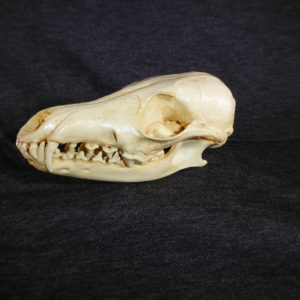
South American Jackal Skull Replica measures 4.9 inches, museum quality polyurethane cast. South American Jackal Skull Replica is 2-part skull (separate cranium and jaw). Known as South American Gray Fox.
The South-American Gray Fox or South American Jackal, commonly called Raposa in Portuguese, or Zorro in Spanish, are a genus of the family Canidae from South America.
Despite their name, they are not true foxes, but are a unique canid genus related to wolves and jackals, which somewhat resemble foxes due to convergent evolution.
The South-American Gray Fox or South American Jackal, is the most common species, and is known for its large ears and a highly marketable, russet-fringed pelt.
Their head is reddish-brown flecked with white. The ears are large and there is a distinct black spot on the chin. The pelage is brindled, with agouti guard hairs and a short, dense pale undercoat. The underparts are pal grey. The limbs are tawny and the thighs are corssed by a dark bar. The long, bushy tail of these animals has a dark dorsal stripe and dark tip with a paler, mottled underside.
The average Gray Fox skull is about 5 inches long. The skull is made up of the cranial bones (cranium) and the facial bones (which include the mandible). The joints of the cranial and facial bones are call sutures.
The South American Jackal is found in the Southern Cone of South America, particularly in Argentina and Chile.
In Argentina, the South American Jackal inhabits the western semiarid region of the country, from the Andean spurs to meridian South from the Río Grande, the distribution of the fox widens reaching the Atlantic coast.
The South American Jackal was introduced to the Falkland Islands in the late 1920s early 1930s and is still present in quite large numbers on Beaver and Weddell Islands plus several smaller islands.
The diet varies in different parts of its range and at different times of year. It consists mainly of mammals, birds, arthropods, bird eggs, reptiles, fruit and carrion.
The main prey items seem to be small mammals, especially rodents. Fruits eaten include Cryptocarya alba, Lithraea caustica and Prosopanche.
The South American Jackal breeds in early austral autumn, around March. After a gestation period of two months, two to four kits are born in a den.
The South American Jackal is a largely solitary animal that has long been hunted for its pelt. The foxes sometimes go near human habitations in search of food, such as chickens and sheep, but tend to avoid areas visited by dogs.
They are useful in their role as scavengers of carrion and as dispersers of the seeds of the fruit they eat.