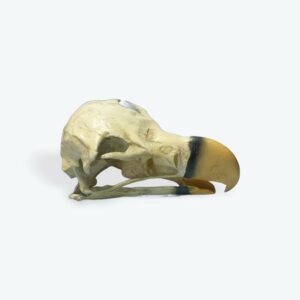
T. tracheliotos Skull Replica or Lappet Faced Vulture measures 6.0 inches. T. tracheliotos Skull Replica is museum quality polyurethane cast. 2-part skull (separate cranium and jaw). Made in USA.
The T. tracheliotos or Lappet-faced vulture is an Old World vulture belonging to the bird order Accipitriformes, which also includes eagles, kites, buzzards and hawks. It is the only member of the genus Torgos.
The T. tracheliotos or Lappet-faced vulture is a huge species, ranking as the longest and largest winged vulture in its range. The bill, at up to 3.9 in. long and 2.0 in. deep, ranks as one of the largest of any accipitrid.
Lappet-faced vultures are generally solitary birds. They do not nest in cohesive colonies as do many smaller vultures, with one tree or area usually only having one to two nests in it, though rarely up to 10 nests have been recorded in one area.
T. tracheliotos or Lappet-faced vultures are monogamous breeders and pairs mate for life. They are solitary nesters, preferring to be far distant from other pairs that are nesting. Intensive defense of the nest, courtship-feeding and mate-guarding make up the mating rituals.
The time of the breeding season is different, depending on the location. In East Africa Lappet-faced vultures breed throughout the year, but in southern Africa breeding is probably from May until mid-summer when fledging takes place, and those in the very north of the range breed from November until July (sometimes to September).
A pair builds a large, bulky, flat nest out of small sticks, lined with dry grasses, at the top of a thorny tree.
They lay one egg which is white with rusty-colored splotches and is incubated by both parents for around 7 to 8 weeks.
The home range of a T. tracheliotos or Lappet-faced vulture is usually at least 8 to 15 km. Groups of up to 25 to 50 Lappet-faces may congregate at large carcasses or watering holes, though typically only from one to as many as seven turn up per carcass.
Overall, the lappet-faced vulture is blackish above with a strongly contrasting white thigh feathers.
The black feathers on the back of African Nubian vultures are lined with brown, while Arabian birds are dark brown rather than black above. The underside can range from pure white to buff-brown.
Like many vultures, it has a bald head. The head coloration can range from reddish in southern Africa to dull pink in more northern Africa to pink on the back of the head and gray on the front in the Arabian Peninsula. The combination of the colorful head and fleshy folds on the side of it are distinctive.
The T. tracheliotos or Lappet-faced vulture is a scavenging bird, feeding mostly from animal carcasses, which it finds by sight or by watching other vultures.
More so than many African vultures, T. tracheliotos often find carrion on their own and start tearing through the skin.
They are the most powerful and aggressive of the African vultures, and other vultures will usually cede a carcass to the lappet-faced vulture if it decides to assert itself.