

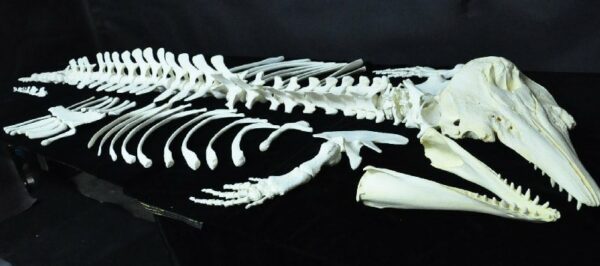

Beluga Whale Disarticulated Skeleton Replica
$4,815.00
As a cast of the SDNHM specimen, this replica is favored by educators because the 7 neck vertebrae are separate. Allowing for physical demonstration of the “nodding” motion of a beluga.
- Description
- Additional information
Description
Beluga whale disarticulated skeleton replica measures 125.0″L x 44.5″W x 30.0″H. Museum-quality polyurethane resin cast from San Diego Museum of Natural History specimen. 1:1 scale (Life Size), Made in USA.
Beluga whale disarticulated skeleton bone count Anatomical Replica
The replica includes all the major structural elements of the San Diego Museum of Natural History specimen. The disarticulated set bone count:
- Skull: 1 (Cranium).
- Mandible: 1 (Lower jaw).
- Vertebrae: ~50 pieces (Includes 7 unfused cervicals, thoracic, lumbar, and caudal.
- Ribs: 22 total.
- Pectoral Fins: two solid pieces (left and right).
- Vestigial hips: 2.
- Chevron Bones: ~15–20
- Flipper: humerus, radius, and ulna are separate.
- Phalanges: cast as a single “paddle” with the bones embedded in a resin matrix.
- Hyoid: The hyoid apparatus.
Skeletal Information (SDNHM Specimen)
- Dorsal Ridge: There is no dorsal fin bone; the skeleton shows a hardened dorsal ridge instead, an adaptation for swimming under Arctic ice.
- Echolocation Support: The skull has a distinctive flat facial plane that acts as a structural base for the “melon,” the fatty organ used to focus sound.
The Beluga whale or Delphinapterus leucas is an Arctic and sub-Arctic cetacean. It is also known as the White whale, as it is the only cetacean of this color; the sea canary, due to its high-pitched calls; and the melon head, more commonly refers to the melon headed whale, which is an oceanic dolphin.
Like most toothed whales, Beluga whale or Delphinapterus leucas has a compartment found at the center of the forehead that contains an organ used for echolocation called a melon, which contains fatty tissue. The shape of the
Beluga whale or Delphinapterus leucas head is unlike that of any other cetacean, as the melon is extremely bulbous, lobed and visible as a large frontal prominence.
The Beluga whale or Delphinapterus leucas body is round, particularly when well fed, and tapers less smoothly to the head than the tail. The sudden tapering to the base of its neck gives it the appearance of shoulders, unique among cetaceans.
The tail fin grows and becomes increasingly and ornately curved as the animal ages. The flippers are broad and short, making them almost square shaped.
The Beluga whale or Delphinapterus leucas are gregarious and form groups of 10 animals on average, although during the summer, they can gather in the hundreds or even thousands in estuaries and shallow coastal areas.
They are slow swimmers, but can dive to 2,300 ft. below the surface. They are opportunistic feeders and their diets vary according to their locations and the season.
The Beluga whale or Delphinapterus leucas feeding habits depend on their locations and the season. the diets of these cetaceans consist mainly of capelin, smelt, sole, flounder, herring, sculpin and other types of salmon.
They also consume a great quantity of invertebrates, such as shrimp, squid, crabs, clams, octopus, sea snails, bristle worms and other deep-sea species.
Scientific classification:
Domain: Eukaryota
Kingdom: Animalia
Phylum: Chordata
Class: Mammalia
Order: Artiodactyla
Infraorder: Cetacea
Family: Monodontidae
Genus: Delphinapterus
Lacépède, 1804
Species: D. leucas
Binomial name: Delphinapterus leucas
Conservation status: Least Concern
This specimen is ideal for hands-on research and is also available as a fully articulated beluga whale skeleton replica cast.
For a comprehensive study of whale scale, pair this specimen with our museum-grade pygmy sperm whale skeleton replica cast.
The Beulga whale skeleton replica is an authentic, 1:1 scale (Life size) reproduction molded from San Diego Natural History Museum specimen.
Additional information
| Weight | 65 lbs |
|---|---|
| Dimensions | 125.0 × 44.5 × 30.0 in |
You may also like…
-


-


Killer Whale Skull Replica
Price range: $1,300.00 through $1,650.00Select options This product has multiple variants. The options may be chosen on the product pageQuick View -
